So, the heyday of using corncobs for a smoking medium is past unless you have a source locally for it. With the remnants of corn sugar, they burn well but not as hot as ensilage does with the corn in it, they have a sweeter smoke than hardwood, and they smolder well. If they're wormy, it just adds to the flavor, lol!
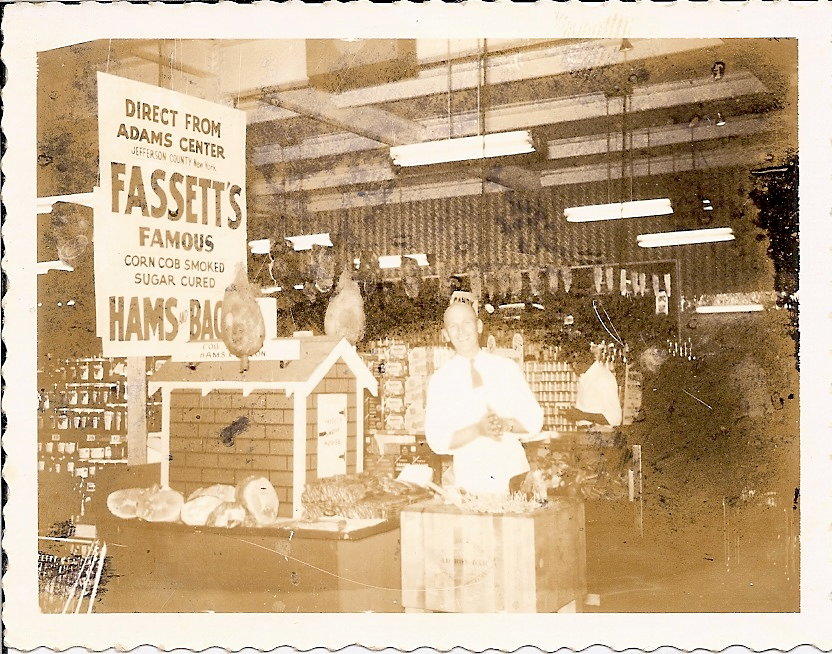
We'd get our fresh hams from Tobin Packing Co. in Rochester in batches of 36 hams at a time, 12-14 lb. raw weight per. They (normally) would be pretrimmed with the hocks cut off. We would unpack them, then get out the pickle pump and pump them, injecting each 7 or more times in specific areas so they would be thoroughly pumped (see my ham thread below to find out how and where), then toss into barrels (55 gal. drums - 2), cover with brine and weighted down with 5 gal. water jugs partially filled. Then roll them into the brine cooler and record the barrel information, date, etc. on a big chart we would make up.
21-30 days later we would rotate the product through and out of the brine cooler to prepare for the smokehouse, emptying the barrels with a long hand hook to a meat truck that we'd roll out to the meatroom where we'd sack each ham from a huge roll of stockinette.
Dad had two rows of smoke sticks three deep. You would sack each ham in stockinette and tie the square knots so that the ham would hang on the ham hook the thinnest so you could fit 6 hams on a stick. Three rows deep of hams 6 each by two rows high, total of 36 hams to a smokehouse.
You would start the smokehouse approx. 7 am, feeding cobs every half hour into the pan, pulling it out to fill then pushing back in over the propane flame to let smolder. The hams smoked the first day to 6 pm, the thermostat set to a constant temp of 145° - 150° until the hams reached an internal of 135°. Some hams, as long as they were 135° or greater, were pulled then and hung for 'uncooked hams'. The temp was lowered to 130° overnight. The next morning the temp was raised to 160° and continued to cook with no more smoke until temp internal was a minimum 146°, then these were pulled as 'fully cooked' hams. (They were all pulled and hung into a separate drip cooler):
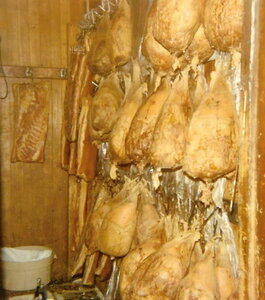
bellies, uncooked hams, cooked hams hanging in the drip cooler.
On the bellies, we would get the bellies from Pilgrim Packing in Syracuse in 350 lb. batches. We would put down the bellies in 55 gal drums, 2 of them, laying them flat and rotating them, sometimes putting two small ones side by side, either skin up or skin down, didn't matter. We'd cover them with brine and weight them down with 5 gal. collapsable water bags partially filled to keep the product submerged and roll them into the brine cooler, again recording the barrel no's and dates on our big chart to let sit and cure for 21 - 30 days.
We'd rotate product through the brine cooler sometimes several times a week depending on business, but we always smoked at least a minimum of 350 lbs of bellies and 36 hams a week for sale, and most weeks two or three more batches.
Of course, we always had side products to do too - hocks, ears, snouts, tails, chickens, turkeys, dried beef, corned beef to pickle, sometimes pastrami to smoke, beef plates for beef bacon, whole smoked beef livers, smoked tongues, Canadian bacon, you name it if it moved at one time we probably smoked it!