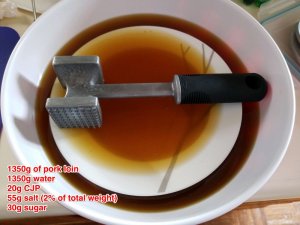
Thank you for the calculations. The deal with cure#1 is that it's a synthetic product. I am going to take my chances and use CJP for now.
I’m not necessarily advocating in favor of making your own Cure#1; just following up on Zwiller’s comment that it is possible. I personally wouldn’t bother for the same reasons everyone else mentioned. If CJP works for you, and you wife’s health benefits, that’s great. I’ve never played with it, but probably will try it at some point.
Regarding Cure #1 being synthetic: I don’t think we have the same definition of that word. Cure#1 contains a synthetic ingredient: Red#3. If you think you need to avoid it, its best to avoid it.
(
https://toxnet.nlm.nih.gov/cgi-bin/sis/search/a?dbs+hsdb:@term+@DOCNO+7974)
NaNO2 on the other hand exists in nature, and it’s the same molecule whether it’s plucked from a celery stock or gown in a lab. Same with salt: It’s NaCl weather you evaporate sea water, grow it in a lab, or dig it out of the ground. So for me, it comes down to impurities/contaminants: known, unknown, natural, synthetic, and their relative concentrations. In CJP, the concentrations of NaNO2, and NaNO3 are unknown. Trace contaminants would include dirt, fertilizers, and animal poop. The sea salt it’s mixed with contains unknown concentrations common ocean pollutants like heavy metals and micro plastics along with seaweed, and more animal poop. With Cure #1, the ingredients list is certain, and trace contaminants are mitigated. When it comes to the chemistry of curing meats, I want to control as many variables as possible.
For the record, I’m not knocking “natural” ingredients. I cook with sea salt, buy organic foods, and so forth. I’m just commenting on the “natural” label and how, at least to me, it’s sometimes misleading.