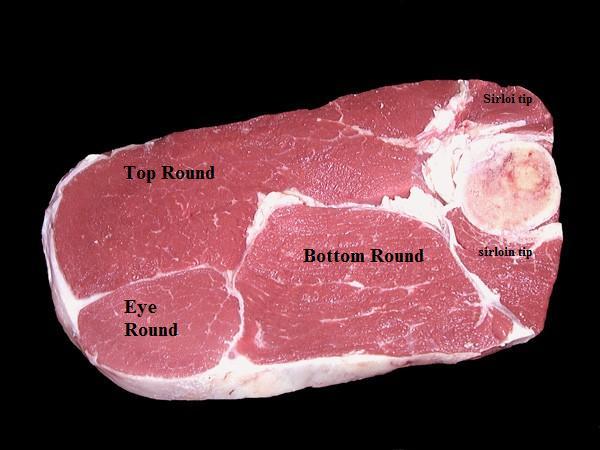
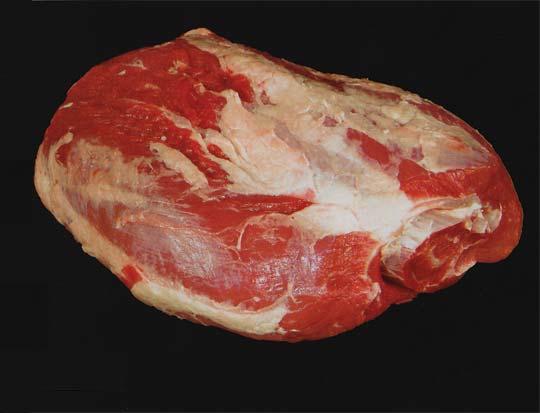
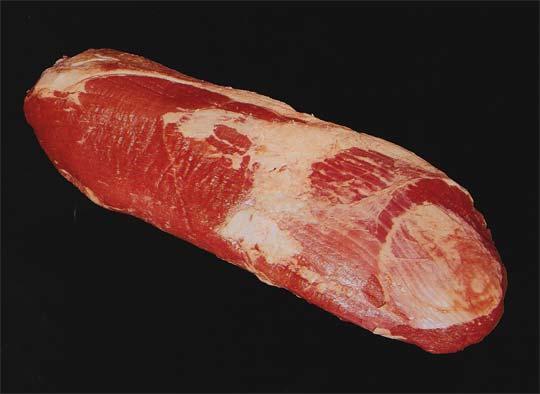
A Bottom Round can contain up to 3 muscles...So depending on the butcher or processor, one, two or all three may show up in the case labeled " Bottom Round "...JJ
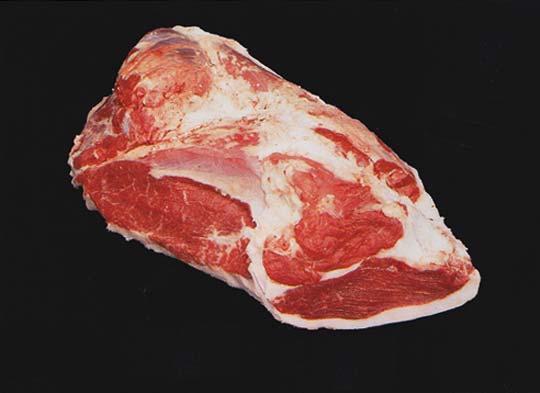
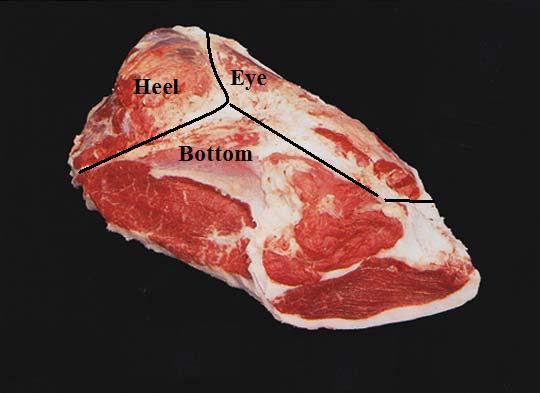
The #170 Bottom Round (Gooseneck) is removed from the primal beef round (IMPS/NAMP 158) and contains the eye, outside round (flat) and the heel. This cut is often referred to as the gooseneck.
The #170A Bottom Round (Gooseneck), Heel Out is the same as the #170 with the heel muscle removed. It still contains the eye and outside round (flat).
The #171B Outside Round (Flat) is cut from the bottom round with the heel, eye, bones, cartilage and heavy connective tissue removed. Because it is leaner, the flat has a higher cooked yield than the gooseneck.
This pick shows the Eye Round (Bottom Left), the Outside Round (Top) and the Heel (bottom middle). Pops can verify but I believe the Heel gets trimmed and is what Craig has that is labeled Bottom Round...
That's what most people do with it, but since you cook the flavor out of it in "SOS", I prefer to use the lousy store-bought Dried Beef for SOS. Actual SOS is made with ground beef---Not Dried Beef (Learned that in the Army).
I make Sammies with Dried Beef, American Cheese, Horse Radish, and Miracle Whip (or Mayo).
Or I mix up some Horse Radish & Philly Cream Cheese. Then plaster it on Dried Beef slices, and roll them up for snacks.
Bear
Actual SOS is made with ground beef---Not Dried Beef (Learned that in the Army).
From Wikipedia, modified 5/22/13:
[h1]Chipped beef[/h1]
From Wikipedia, the free encyclopedia
Chipped beef
[th=""]Origin[/th]
[th="row"]Place of origin[/th]
[th=""]Details[/th]
[th="row"]Type[/th]
[th="row"]Main ingredient(s)[/th]
Chipped beef is thinly sliced or pressed salted and dried
beef. Some makers
smoke the dried beef for more flavor. The modern product consists of small, thin, flexible leaves of partially dried
beef, generally sold compressed together in jars or flat in plastic packets. The processed meat producer
Hormel once described it as "an air-dried product that is similar to
bresaola, but not as tasty."[sup]
[1][/sup]
[h2]Availability [
edit][/h2]

Individual sliver of chipped beef
Chipped beef is served in many diners and restaurants in the United States as a breakfast item. Creamed chipped beef is standard fare on many such diner menus, especially in the Mid-Atlantic and Northeast, but has become harder to find in chain restaurants that serve breakfast; among the restaurants still offering chipped beef on toast are
Golden Corral and
Silver Diner.
IHOP no longer offers this on their menus, having substituted
sausage gravy, and the same is true for
Cracker Barrel restaurants. It is also available from companies such as
Stouffer'sin a frozen form which can be put on top of separately-prepared toast; It is typically quite salty, for instance, Stouffer's creamed chipped beef contains 590mg sodium per 5.5 ounces (160 g) serving.[sup]
[2][/sup] The mixture was also, at one point, available from both
Freezer Queen and Banquet as "hot sandwich toppers"; as of late 2007, Freezer Queen no longer makes this product, and the Banquet variety is rarely found. Finally, both the Esskay Meat Company of Baltimore and
Knauss Foods make a refrigerated version of creamed chipped beef which can be easily microwaved. The meat itself is also available for purchase under the Knauss, Carson's Brand names.
[h2]Chipped beef on toast [
edit][/h2]

Creamed chipped beef on toast
[h3]U.S. military cuisine [
edit][/h3]
Chipped beef on toast (or creamed chipped beef on toast) is a
culinary dish comprising a
white sauce and rehydrated slivers of dried beef, served on toasted bread. Hormel recommends flavoring the dish with
Worcestershire sauce and dried parsley. In
military slang it is commonly referred to by the
dysphemism "
Shit On a Shingle" (SOS)—or, "Stew On a Shingle", "Same Old Stuff", "Something On a Shingle", or occasionally "Save Our Stomachs". Chipped beef is also often served on
bagels,
English muffins,
biscuits,
home fries,
rice, and in
casseroles.
Wentworth and Flexner cite no origin, but noted "shingle" for slice of toast has had "some use since 1935" in the U.S. Army, mostly in the expression "shit on a shingle", and the latter had "wide
World War II Army use".[sup]
[3][/sup]
In the United States, chipped beef on toast was emblematic of the military experience, much as
pea soup is in
Finland or
Sweden.
Chipped beef on toast (S.O.S.) is the title of a book of military humor.[sup]
[4][/sup] In his World War II book
Band of Brothers,
Stephen E. Ambrose evokes the military basics:
At the end of May, the men of
Easy packed up their barracks bags and … [took] a stop-and-go train ride to
Sturgis, Kentucky. At the depot
Red Cross girls had coffee and doughnuts for them, the last bit of comfort they would know for a month. They marched out to the countryside and pitched up tents, dug straddle trenches for latrines, and ate the Army's favorite meal for troops in the field, creamed chipped beef on toast, universally known as SOS, or Shit on a Shingle.[sup]
[5][/sup]
[h2]See also [
edit][/h2]
[h2]References [
edit][/h2]
- ^ "Dried Beef Products". Hormel. Archived from the original on 2007-03-11. Retrieved 2008-09-03.
- ^ "Creamed Chipped Beef". Stouffer's.
- ^ Wentworth, Harold; Stuart Berg Flexner (1967). Dictionary of American Slang (supplemented ed.). New York, NY: Thomas Y. Crowell.
- ^ Bertram, Charles S. (2003). Chipped Beef on Toast (S.O.S.). ISBN 0-7414-1554-2.
- ^ Ambrose, Stephen E. (2001-06-06). Band of Brothers: E Company, 506th Regiment, 101st Airborne from Normandy to Hitler's Eagle's Nest. New York, NY: Simon & Schuster. ISBN 0-7432-1645-8. Retrieved 2008-09-03.
[h2]External links [
edit][/h2]
Media related to
Chipped beef at Wikimedia Commons
Categories:
[h2]Navigation menu[/h2]
[h3]
Interaction[/h3]
[h3]
Toolbox[/h3]
[h3]
Print/export[/h3]
[h3]
Languages[/h3]
Hamburger was substituted for dried beef, but the original SOS was with dried, chipped slivers of beef, not hamburger. In times of war beef was scarce in muscle form.
It was beef, buffalo or other animals that was cured and smoked to dry it, as in that form it would keep without refrigeration on the long journeys migrating masses would use. Indians would hang up meat in their tents after salting to dry it above the open fire, for example. Otherwise, it would spoil quickly and not be fit for transporting long distances.
Parts of the round steak, bone in:
A whole gooseneck:
It's parts:
con't:
Heel:
Whole Eye of Round:
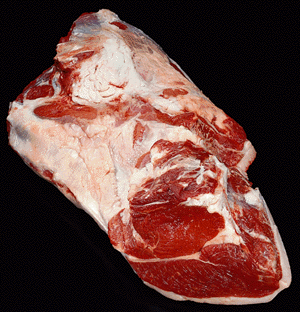
Beef whole bottom round;
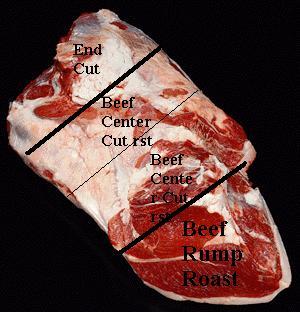
Beef Whole Bottom Round (w/rump sectioned off):
Grain runs diagonal on the piece, so slice across the grain.
These are the parts of the gooseneck and how they are sectioned out. Bottom Round can be tender when cooked medium rare, max, and sliced thin across the grain. Rump is the tenderest, End cut is the toughest. The heel is seamed out for cubes and stew; the center muscle looking like a rope is seamed out for longboil stew, like a soupbone - stringy and tough.