Total noob to curing

  • Some of the links on this forum allow SMF, at no cost to you, to earn a small commission when you click through and make a purchase. Let me know if you have any questions about this.
SmokingMeatForums.com is reader supported and as an Amazon Associate, we may earn commissions from qualifying purchases.
To touch on my back ground the 1st time I slow cooked a pork butt for pulling I did it with no seasoning for my own baseline. It came out with what I'll call a still on the hoof flavor. This experiment had about the same flavor.
Seasoning has been added to my slow cooked pork butt and is now requested.

Plain smaller piece on left, lightly black peppered the bigger one. Went in the oven @350. Out of the oven picture below.
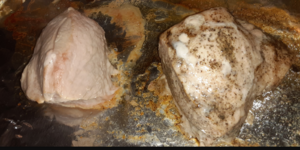
1stcook.PNG

Small one not pictured below made it to165f and was too tough, the dog loved it.
Peppered one pictured below cut open made it to 160f I ate some of it and nothing to write home about but not deterred.
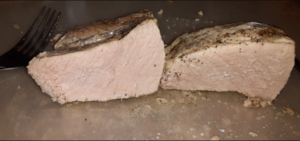
1stcooked.PNG

I'm not ready to rush into eating up the fridge space with another soak but would like to try and improve a baseline loin.

Research and learning continues.
 
My cure 1 went in the water post boil, but I didn't check the temp and couldn't tell if it went in at 200 or 180. It was still hot, far over 130f but not boiled.
Not that it makes a difference at this point.
Just another tid bit of information.

I think it is a very good idea to NOT BOIL your pink salt or prague powder. The chemistry of meat cures is not terribly complex and it goes like this. Nitrate ions can be reduced to nitrite ion by fermentation bugs over time. The nitrite can be further reduced to nitric oxides which DO THE CURING by reacting with meat proteins like myoglobins to create the pick color. Using just a small amount of very reactive nitrite allows the cure to be much safer as the extra abundance of nitrate is not needed when using an insta cure made with nitrite. BUT nitrite can be oxidized back to nitrate so you want there to be enough to get the job done without exhausting them to zero before the cure completes. A reason to boil your salt, sugar brine is definitely to kill off as much bacteria and fungi as possible. Yes the spores can survive this boiling but only spores can survive boiling for any length of time including the tough to kill C, botulism spores. That is why canned foods with low acidity have added acids (green chilis etc) to keep the C. botulism from growing in the low acid media. Same for meat cures. Unless it ferments to make it a sour dry ferment, the added nitrites kills off the C. botulism bacteria that somehow survived as spores.

Nitrites are less stable in solution and capable of being oxidized OR reduced. Reduction to nitric oxide in solution is the desired step to effect a meat cure but nitric oxide is REALLY UNSTABLE in liquids or as a gas. It is a super reactive short lived species (it will react with many molecules including proteins and fats) and also volatile so until it reacts with the meat it can also just outgas into the air or volatilize away as it is also a gas and a big component of smog etc.
 
  • Like
Reactions: chef jimmyj
Started this on 12-10-20 about 7:pm
Goal is pink cured pork with no added seasoning.
Bought a 5lb pork loin.

Cut 2 lbs off and gently scrubbed in fresh water.
Boiled 2.5 quarts of water with 6.6 grams of Prague #1 let cool.
Placed 2 lb of pork with cooled water in zip lock bag in fridge.
Now we wait.
At the loins thickest section it is 3" thick.

I'm getting mixed calculations but leaning towards a 6 day cure.
Does that sound right?

As of last night.
The liquid has a tint to it but can tell the meat is pink on the outside.
The fat I left on it has turned white.

View attachment 475463
I would add to this that I don’t believe that whole muscle meats can be effectively cured without at minimum 1.5% salt to total weight. The 2% salt range is most commonly used. 3% would be a maximum limit but imparts a very salty finished product. The reason for the salt either in dry rub or in solution (brine) is that concentrations of salt in that 1.5% to 3.0% help to kill bacteria and stop its growth, as well as extracting moisture from the meat. This water/moisture extraction causes a vacuum inside the whole muscle that allows for greater uptake of the brine and or dry rub containing the cure. This helps get the cure into the center of the meat. As I understand stand it, the cure will follow the salt as it penetrates the meat. Cured meat as a rule is salty. However when making cured meats at home you can control the salt percentage to match your preference within the percentage range I posted. For me personally I use 1.5% salt then once the cure is added it takes my over all salt to about 1.75%. This works just fine and I prefer the lower salt taste. Sugar can also be added but is not necessary to cure. It’s added to offset the saltiness and to add a sweetness to the final finished product. I use 1.0% sugar but your taste may be different. Again I do not believe that whole muscle meat can be successfully cured without a concentration of added salt. Cure#1 alone is not enough. Hopefully others will chime in.
 
  • Like
Reactions: rjob
There were 3 things done on this run that are not typical: boil cure, use cure only, and not inject meat over 2" thick. It is interesting all 3 things are debatable and lack a clear understanding. I remember being there and wondering about it myself. I researched heavily and did not find much and what I did find were conflicting theories. For some reason, I just jumped in with Pops brine. Success! Maybe a little salty and sweet for my tastes but success. From here I adapted to Omak/Marianski weight based curing and injecting, and my results were much better to my tastes BUT now I knew the variables and could play around a bit.

I am also no expert but have cured a few years now and consider myself well read on it. My take:
1. Heat does not really affect cure for the most part. I add cure last to my brine while still warm and no issues. If I had to hazard a guess why it is typically not recommend to boil cure I would say it might have to do with the variations in water composition. Water composition makes radical difference brewing beer...
2. I think you need at least 1% salt to cure but do not know for sure. 1% works, I've done it, but this is lowest I did. You are welcome to take one for the team and try .5%. I know for a fact you do not need sugar as I have stopped using it for some time now and have no issues.
3. You do not need to inject but it will offer much faster, consistent, and uniform results.
 
  • Like
Reactions: chef jimmyj
This leads up to the next item of debate: is cure ALONE sufficient to cure? I vote no. Al beat me...
I’m no expert on curing, but I was always told to use salt & sugar with the cure. Those are the only 3 ingredients necessary for curing. I guess the old timers just used salt as a cure, but I don’t think you get that hammy flavor without cure. So to answer your question I vote no too.
Al
Well, both Cure #1 and Tender Quick are mostly salt so the real question is how would sodium nitrite perform on its own. But how would you accurately measure and apply?
Along the lines of both of your questions, shortly after Blonder wrote this article I tried it on a small brisket flat. He calls for only Cure #1 and salt and the overall amount used is so small you have to take great care to apply. For my experiment I only needed 3/4 teaspoon TOTAL, so gently bouncing it on the brisket was a pain. Bottom like for me was a GONG. It did have the proper color, but the saltiness was light (and I favor lighter salt amounts).

 
Well this thread sure has gotten a lot of interest. But my take on it is I will continue to use the diggingdogfarm calculator, http://diggingdogfarm.com/page2.html to cure any meat I cure that uses cure#1, and will NOT heat the cure#1 before smoking the meat. I guess I’m old school, but that is the way I have been doing it since I started curing meat & will continue to do so. It’s hard to change when you get old & have a routine that works.
Al
 
  • Like
Reactions: chopsaw
Well this thread sure has gotten a lot of interest. But my take on it is I will continue to use the diggingdogfarm calculator, http://diggingdogfarm.com/page2.html to cure any meat I cure that uses cure#1, and will NOT heat the cure#1 before smoking the meat. I guess I’m old school, but that is the way I have been doing it since I started curing meat & will continue to do so. It’s hard to change when you get old & have a routine that works.
Al
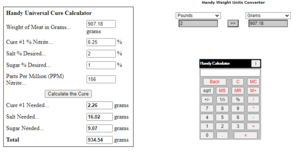
Using that calculator for the piece of meat I had.

Can I seal these ingredients in a bag, 2 or 4 cups of water, for how long?
Things I just don't know yet.

calc.PNG
 
Using that calculator for the piece of meat I had.

Can I seal these ingredients in a bag, 2 or 4 cups of water, for how long?
Things I just don't know yet.

View attachment 475811
This is for a dry cure.
For a brine cure I use Pop’s brine. It’s very basic & you can add any spices to the brine you want, but if the piece of meat is more than 2” thick then you need to inject the brine into the meat before you soak it in the brine.
Here is Pops brine recipe:
Al
 
Last edited:
If you use the calculator, it gives you the ingredients as a dry rub. When applied to the meat and bagged, it will produce a light brine in the bag as moisture is drawn from the meat. If you want to add water. As you mentioned 2 or 4 cups, you can but need to include the weight of the water in with the meat. This is equilibrium cure calculator so include the weight of meat and water, if used.
 
  • Like
Reactions: chef jimmyj
To answer... How Long in the Bag?

The common Standard for Brines...7 Days per Inch of thickness. Plus a day or 2, uncovered in the refer, to form a Pellicle.

For Dry Rub Curing, with/without adding 4 to 8 Ounces of Water to the bag... 1 day in the bag for each 1/2 Inch of thickness, massage and turn daily. Plus 2 days, uncovered in the refer, after Rinsing to come to equilibrium and form a Pellicle.

A 4" thick Pork Loin in a Bag with the proper amount of Dry Rub of Cure #1 and Salt per the Calculator, for the Weight of the meat and 4 ounces of Water, will require 8 days in the Bag. Then, rinse well and Rest in the refrigerator, Uncovered, for 2 more days to equilibrate and form a Pellicle...JJ
 
None of my examples are Open to Air, except the last 2 days and that is for Smoking the Meat, Only.
If you are just going to roast or poach it. You still need to Rinse and Rest 2 days BUT it can be Wrapped and stored in your refer, as a Pellicle is not needed...JJ
 
None of my examples are Open to Air, except the last 2 days and that is for Smoking the Meat, Only.
If you are just going to roast or poach it. You still need to Rinse and Rest 2 days BUT it can be Wrapped and stored in your refer, as a Pellicle is not needed...JJ
I'm in Florida it's not cold enough to smoke for 2 days. I will not be playing with meat in the temperature danger zone.

I'm going to need to go from refrigerator to cooking.
Having a hard enough time convincing my wife to go beyond the use by date without freezing or cooking, she's not going to have a piece of meat airing out resting in the fridge for 2 days.
When you say wrapped can that be re ziplock bagged or vacuum sealed?

If a gallon or more of water is needed to do what I want "pops real simple curing brine"
This will become a rarity rather than a new hobby.
Learning
Thanks again.
 
When you say wrapped can that be re ziplock bagged or vacuum sealed?

If a gallon or more of water is needed to do what I want "pops real simple curing brine"
This will become a rarity rather than a new hobby.

Yes, you can Bag or Seal. The meat just needs a couple days to Equilize.

If Space is an Issue, Use the Dry Rub and a Small amount, 4-8oz,of Water, in a Zipper Bag! It takes Less Time than Pops Brine, takes Less Space and gives a great product.

A little FYI...Thousands of people Smoke Cured Meat in Florida, Year Round! The two Largest Member Gatherings take place Spring and Fall in Florida, there are That Many Floridian SMF Members.
Smoking CURED MEAT, for 8 hours a day, for 1, 2, 3, even 7 days, refrigerate the meat in between, is PERFECTLY SAFE and has been done in the Hot Southern States for Hundreds of years.

I'm a retired Pro Chef and Certified Food SAFETY Instructor. There is No Way, I would give you false or Unsafe information...Do what you feel comfortable with...JJ
 
Thanks

Stay safe, but how do I come up with these safe numbers?
Use this calculator for the ingredients.
add a few oz. of water
bag it let it set for some days (assume manipulate the bag occasionally, twice a day)
rinse rebag to equalize for about 2 more days
rinse again?
Then cook to safe temperature. safe temp chart is clear and easy to understand. Lets not mess with that for now.

I'm pretty sure all the correct information has already been posted but it's not clicking in my mind.


I have no issues with smoking. When I do take that step, I'm not jumping right into smoking/cooking at under 220f more like 240 or more incase I miss a temperature drop.
 
There is no such thing as a Perfect Formula in curing and smoking. I can't say take... 10g of Cure and 40g of Salt for X days then this and that and some more of whatever...
Every Piece of Meat is Different! So, Every weight of Ingredient and time in the Refer and Rest Time and Smoke Time and Smoke Temperature, and Ambient Temperature in Florida on August 10th...Will Be Different!

We can teach a CONCEPT called Curing and Smoking Loin Bacon/Irish Bacon/Canadian Bacon/Back Bacon, (different names for basically the same meat). We can give you basic Guidelines for How much Cure, Salt and Sugar, Time in the Cure, Time Resting, Time Smoking, Temp of the Smoker and Meat...But there are no How To's, Step by Steps, Tutorials, Recipes or Formulas that WILL APPLY EVERY TIME. There are just too many Variables that you have to adjust to each time you Cure or Smoke a piece of meat.

Learn the Concept, then the Details will make more sense and fall in place ...JJ

Here are a couple Hundred ways Loin Bacon went from Raw Pork to Plate. ALL different numbers, but ALL the Same Concept...Cured and Smoked Pork!

 
I have a question. If your boiling the water with the cure in the water. Wouldn't that change the ratio of the cure to water?

Chris
 
I have a question. If your boiling the water with the cure in the water. Wouldn't that change the ratio of the cure to water?

Chris
I'm pretty sure that it has been hammered into my head that it's a bad idea to boil the cure and we will not be doing that again. Even though it wasn't boiled last time we have learned not to. :)
 
SmokingMeatForums.com is reader supported and as an Amazon Associate, we may earn commissions from qualifying purchases.

Hot Threads

Clicky