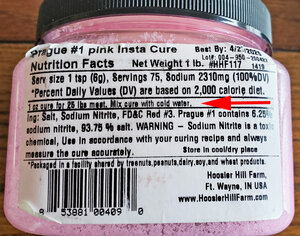
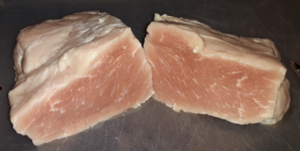
Total noob to curing

  • Some of the links on this forum allow SMF, at no cost to you, to earn a small commission when you click through and make a purchase. Let me know if you have any questions about this.
SmokingMeatForums.com is reader supported and as an Amazon Associate, we may earn commissions from qualifying purchases.
As I learn this will get better, right?
This 2lb experiment isn't garbage yet?
Still inside the use by date that was on the packaging.

.

My friend, have you read what the old time members on here have said. The use by date doesn’t mean anything if you boil the cure.
Read what Dave said & I PM’d chef Jimmy J who is another safety expert to give you an answer. But when curing meat you are taking a big risk of getting sick if you do it wrong, and I have been always told don’t heat the cure before using it.
Al
 
  • Like
Reactions: chopsaw
I'm curious if the performance of sodium nitrite can be affected by simmering or boiling, without actually breaking the chemical bonds?

If you boil the cure/pickle (and then let it cool) before injecting/immersing the meat – The fact that the cure had been boiled will not affect the meat in any way.

The temperature of the pickle - during the curing process - will have a big influence on the speed of the curing process. This is, in part, because the rate of mass diffusion is temperature dependent. The type of bacteria and the speed of bacterial growth will also be affected.

If you put raw, uncured meat into a simmering pickle, you will be curing the meat but also cooking the meat. The cooking (i.e. the denaturation of meat protein) will happen much much faster than the curing (i.e., the Nitrosylation of Myoglobin)

Regarding Marinaski – I’m not saying anything that contradicts him.

Regarding Kutas – I do t have that reference, so i cant comment on specifics, but: "all ingredients” seems to imply “for consistency.” There are other ingredients which will behave differently in hot vs cold water (e.g. aromatics, gelatin, starches).

I talk specifically about breaking bonds since that is what would have to occur for the NaNO2 to somehow stop working - It would have to cease being NaNO2.

Conclusion :emoji_nerd::
Cure#1 in a bucket of H2O is a simple, stable system.
Cure #1 in a muscle is really complicated since it involves mass transport, chemical reactions, and biological systems.
 
  • Like
Reactions: thirdeye
Sometimes the obvious is a good resource.... I've used enough Cure #1 in my life to fully preserve a mastodon and other than verifying the 6.25% sodium nitrite, apparently, I've never read the label. :emoji_laughing:
e6LsfM1.jpg
 
All I have so far is heating #1 may be bad.
Some are pretty sure about it others not so sure about it.
I won't pre heat the cure again either way.

Before coming here weight of #1 was far more important than volume of #1. Need a gram scale or don't bother, spoons won't be accurate enough.
Now I'm here looking around and spoon measuring #1 per lb of meat looks acceptable, accuracy once assumed needed is out the window, with little concern for amount of water seems just fine. Nothing cures pollution like dilution, making the amount of water seem rather important in the whole ratios thing.


Science and accuracy brings me right back to THIS.
"If anything has been consistent in this adventure it has been inconsistency.
Please, forgive me for my frustration.
The who's right and who's wrong, which path to follow has become similar to a shouting match on a play ground in my head."


Thanks again for your patience.
 
gandrfab gandrfab Let me add some UNDISPUTED Perspective...What TEMPERATURE are you planning to smoke this meat at?

This Boil, Never Boil the Cure#1 argument has gone on Here, on other sites and in multiple studies, with results showing each side is correct. I don't have the time our desire to search my archives to add to this.
So...I will take a different route and address the SAFETY ASPECT!


So, we address the Growth Temperature range...C.Bot grows between 37.4°F (3C) and 118 4°F (48C). Beyond these temps there is insignificant of No Growth!


So BOTTOM LINE. What TEMPERATURE will the meat be Smoked At?
I suspect the OP is not smoking 48 hours straight at 70-80°F and you all understand or should understand, the Pasteurization Temps for Pork.

Temperature Time Temperature Time
°F (°C) (Minutes) °F (°C) (Seconds)

130 (54.4) 112 min... 146 (63.3) 169 sec
131 (55.0) 89 min.... 147 (63.9) 134 sec
132 (55.6) 71 min.... 148 (64.4) 107 sec
133 (56.1) 56 min.... 149 (65.0) 85 sec
134 (56.7) 45 min.... 150 (65.6) 67 sec
135 (57.2) 36 min.... 151 (66.1) 54 sec
136 (57.8) 28 min.... 152 (66.7) 43 sec
137 (58.4) 23 min.... 153 (67.2) 34 sec
138 (58.9) 18 min.... 154 (67.8) 27 sec
139 (59.5) 15 min.... 155 (68.3) 22 sec
140 (60.0) 12 min.... 156 (68.9) 17 sec
141 (60.6) 9 min...... 157 (69.4) 14 sec
142 (61.1) 8 min...... 158 (70.0) 0 sec
143 (61.7) 6 min.......
144 (62.2) 5 min.......
145 (62.8) 4 min.......

Table C.1: Pasteurization times for beef, corned beef, lamb, pork and cured pork (FDA, 2009, 3-401.11.B.2).

IF this Pork will be Smoked above 130°F as it Typical for Cured Loin, and smoked to an IT of 150°F...The entire argument over Do/Don't Boil Cure is moot from a SAFETY Standpoint!...JJ
 
That will be great and perfectly Safe, with or without Cure #1! Worst case, the Nitrite, dropped below 40ppm in the brine/meat and you may not get that Pink Meat color of Cured Meats, edge to edge. Post pics of the sliced Irish Bacon...JJ
 
Guess I left out this has been setting like pictured in the bottom back of a lightly used refrigerator 34 ° -36 ° f with a pair of . . links not showing for me . Digital Freezer Room Thermometer, Max/Min Record Function.
 
Last edited:
  • Like
Reactions: chef jimmyj
gandrfab gandrfab Let me add some UNDISPUTED Perspective...What TEMPERATURE are you planning to smoke this meat at?

This Boil, Never Boil the Cure#1 argument has gone on Here, on other sites and in multiple studies, with results showing each side is correct. I don't have the time our desire to search my archives to add to this.
So...I will take a different route and address the SAFETY ASPECT!


So, we address the Growth Temperature range...C.Bot grows between 37.4°F (3C) and 118 4°F (48C). Beyond these temps there is insignificant of No Growth!


So BOTTOM LINE. What TEMPERATURE will the meat be Smoked At?
I suspect the OP is not smoking 48 hours straight at 70-80°F and you all understand or should understand, the Pasteurization Temps for Pork.

Temperature Time Temperature Time
°F (°C) (Minutes) °F (°C) (Seconds)

130 (54.4) 112 min... 146 (63.3) 169 sec
131 (55.0) 89 min.... 147 (63.9) 134 sec
132 (55.6) 71 min.... 148 (64.4) 107 sec
133 (56.1) 56 min.... 149 (65.0) 85 sec
134 (56.7) 45 min.... 150 (65.6) 67 sec
135 (57.2) 36 min.... 151 (66.1) 54 sec
136 (57.8) 28 min.... 152 (66.7) 43 sec
137 (58.4) 23 min.... 153 (67.2) 34 sec
138 (58.9) 18 min.... 154 (67.8) 27 sec
139 (59.5) 15 min.... 155 (68.3) 22 sec
140 (60.0) 12 min.... 156 (68.9) 17 sec
141 (60.6) 9 min...... 157 (69.4) 14 sec
142 (61.1) 8 min...... 158 (70.0) 0 sec
143 (61.7) 6 min.......
144 (62.2) 5 min.......
145 (62.8) 4 min.......

Table C.1: Pasteurization times for beef, corned beef, lamb, pork and cured pork (FDA, 2009, 3-401.11.B.2).

IF this Pork will be Smoked above 130°F as it Typical for Cured Loin, and smoked to an IT of 150°F...The entire argument over Do/Don't Boil Cure is moot from a SAFETY Standpoint!...JJ
OK JJ I understand the safety aspect, but I was always told to never boil the brine with cure #1 in it. IS THIS WRONG? I was always told that it would neutralize the cure. Is this true or not? Please clarify.
Al
 
Al, I honestly am not sure. There is research on both sides. I have studied College Level Chemistry and at a point, the studies are beyond my understanding.
I too was told Don't Boil Cure #1/2, as a Newbie, and never have. Besides, the amount of Cure compared to the amount of Water in a Brine, will have ZERO problem Dissolving so why Boil it? Sorry I can't be more definitive with my answer...JJ
 
My cure 1 went in the water post boil, but I didn't check the temp and couldn't tell if it went in at 200 or 180. It was still hot, far over 130f but not boiled.
Not that it makes a difference at this point.
Just another tid bit of information.
 
Well after much discussion, it seems that cure #1 is NOT affected by heat, so I was wrong to tell you that it was. I was taught to always mix the cure in cool water, but it appears that I was wrong. I’m sorry if I caused you any inconvenience, so you are good to go. However I would leave it in the cure for at least 10-12 days.
Al
 
Well after much discussion, it seems that cure #1 is NOT affected by heat, so I was wrong to tell you that it was. I was taught to always mix the cure in cool water, but it appears that I was wrong. I’m sorry if I caused you any inconvenience, so you are good to go. However I would leave it in the cure for at least 10-12 days.
Al
Al, I honestly am not sure. There is research on both sides. I have studied College Level Chemistry and at a point, the studies are beyond my understanding.
I too was told Don't Boil Cure #1/2, as a Newbie, and never have. Besides, the amount of Cure compared to the amount of Water in a Brine, will have ZERO problem Dissolving so why Boil it? Sorry I can't be more definitive with my answer...JJ

I was taught to keep everything cold too. The meat and the curing brine, but hams were usually the items that were cured this way in my family. They were injected (and I have no idea if my grandfather really did a 7% or a 10% pump) and then went into a crock with a cover brine. On a similar note, I was also taught to use canning salt instead of Kosher because it seems to dissolve better in room temperature water..... but I've never done a side-by-side comparison. BTW, I use canning salt in several dry cures, but use Kosher salt for fish.

I guess what I'm wondering is.... how did the recommendation to not add curing salts before heating actually start? I would think it would be after a number of failure to fully cure something.
 
I guess what I'm wondering is.... how did the recommendation to not add curing salts before heating actually start? I would think it would be after a number of failure to fully cure something.

It would appear that heating Cure #1 in water has little effect but the Nitrite in CURED MEAT, dissipated quickly when heated. I would think, at some point, someone extrapolated the the second condition to the first thinking, " Nitrite dissipates when Heating the meat, so it must dissipate ANYTIME you heat it! "...JJ
 
  • Like
Reactions: thirdeye
I Trust P PolishDeli and the Heating Cure Brine Tests he ran. I have seen similar results in other studies. However, there are contradictory reports.

My Official Answer...While there is no good reason to Boil Cure with Brine ingredients, and it is Not Recommended...Several Studies show there is no significant effect on the Cure's potency if you do add it to Boiling Brine...JJ
 
Good morning. The appearance in the bag didn't change from the OP pic. This was right out of the bag and cut open. Not odd odor.
1sthamcutprecook.PNG
 
This leads up to the next item of debate: is cure ALONE sufficient to cure? I vote no. Al beat me...
 
This leads up to the next item of debate: is cure ALONE sufficient to cure? I vote no. Al beat me...

I’m no expert on curing, but I was always told to use salt & sugar with the cure. Those are the only 3 ingredients necessary for curing. I guess the old timers just used salt as a cure, but I don’t think you get that hammy flavor without cure. So to answer your question I vote no too.
Al
 
SmokingMeatForums.com is reader supported and as an Amazon Associate, we may earn commissions from qualifying purchases.

Latest posts

Hot Threads

Clicky