STOP !!! ...... No, you cannot safely ship cured meats.... They have moisture in them... They are NOT pH adjusted... They do NOT have mold inhibitors added.....
NEVER ship cooked meat....
If they're cured,smoked and cooked and then vac sealed I wouldn't worry.
Even without preservatives a Slim Jim or equivalent has one hell of a shelf life.
........
Slim Jim's are preserved.........
Ingredients
A 2009
Wired article listed some of the ingredients as beef, mechanically separated chicken, lactic acid starter culture, dextrose, salt, sodium nitrite and hydrolyzed soy.
[13] They note that although
ConAgra refers to Slim Jim as a "meat stick",
it resembles a fermented sausage, such as salami or pepperoni, which uses bacteria and sugar to produce lactic acid, lowering the pH of the sausage to around 5.0 and firming up the meat.[13]
Sodium nitrite is added to prevent the meat from turning gray,
[13] and hydrolyzed soy contains
monosodium glutamate.
[13]
..........
This
very cool video from Wired puts the ingredient listing into layman’s terms, and it’s a little frightening. It starts with beef (most likely the lower grades from the oldest cows, called utility, cutter, and canner). It’s ground and mixed with mechanically separated chicken, which is the chicken equivalent of “
pink slime” (even though the production process is different), essentially puréed chicken bones, nerves, blood vessels, skin, and a small amount of meat. Sugar, spices, additional flavorings, and a whole lot of salt (one-sixth the daily recommended intake) are then added, along with corn and wheat protein (for texture), and hydrolyzed gluten (which gives it an MSG-like savoriness). Traditional sausage-making ingredients lactic acid starter culture (which keeps the pH balance down) and sodium nitrite (which prevents botulism and keeps the meat red) are then added, and the slurry is piped into a casing and allowed to ferment until ready to eat.
.......
What's Inside a Slim Jim?
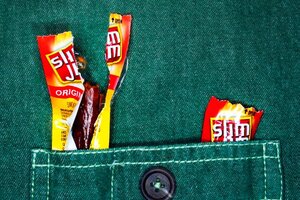
* Photo: Tim Morris *
Beef
It's real meat, all right. But it ain't Kobe. The US Department of Agriculture categorizes beef into
eight grades of quality. The bottom three—utility, cutter, and canner—are typically used in processed foods and come from older steers with partially ossified vertebrae, tougher tissue, and generally less reason to live. ConAgra wasn't exactly forthcoming on what's inside Slim Jim.
Mechanically separated chicken
Did you imagine a conveyor belt carrying live chickens into a giant machine, set to the classic cartoon theme "Powerhouse"? You're right! Well, maybe not about the music. Poultry scraps are pressed mechanically through a sieve that extrudes the meat as a bright pink paste and leaves the bones behind (most of the time).
Corn and wheat proteins
Slim Jim is made by
ConAgra, and if there are two things ConAgra has a lot of, it's corn and wheat.
Lactic acid starter culture
Although ConAgra refers to Slim Jim as a meat stick (yum), it has a lot in common with old-fashioned fermented sausages like salami and pepperoni.
They all use bacteria and sugar to produce lactic acid, which lowers the pH of the sausage to around 5.0, firming up the meat and hopefully killing all harmful bacteria.
Dextrose
Serves as food for the lactic acid starter culture. Slim Jim: It's alive!
Salt
Salt binds the water molecules in meat, leaving little H2O available for microbial activity—and thereby preventing spoilage. One Slim Jim gives you more than one-sixth of the
sodium your body needs in a day.
Sodium nitrite
Cosmetically, this is added to sausage because it combines with myoglobin in animal muscle to keep it from turning gray. Antibiotically, it inhibits botulism. Toxicologically, 6 grams of the stuff—roughly the equivalent of 1,400 Slim Jims—can kill you. So go easy there, champ.
Hydrolyzed soy
Hydrolysis, in this instance, breaks larger soy protein molecules into their constituent amino acids, such as glutamic acid. Typically, the process also results in glutamic acid salt—also known as monosodium glutamate, a familiar flavor enhancer.