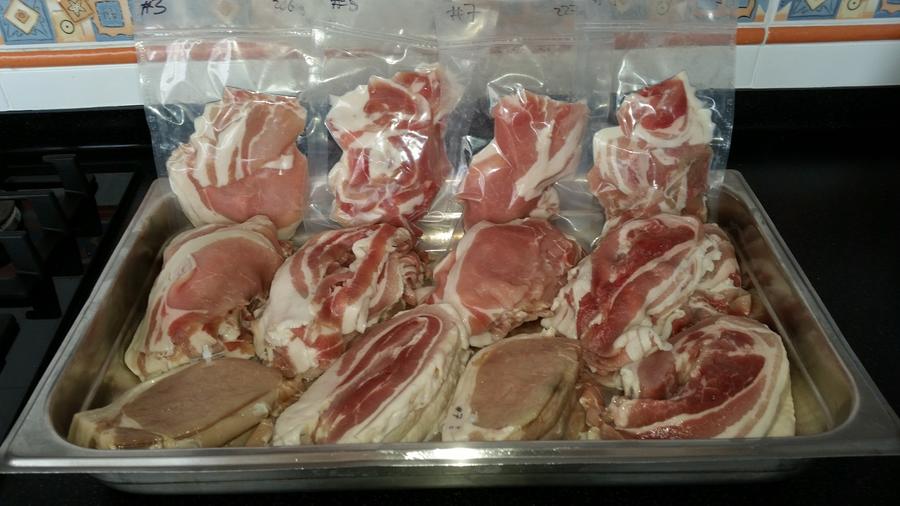
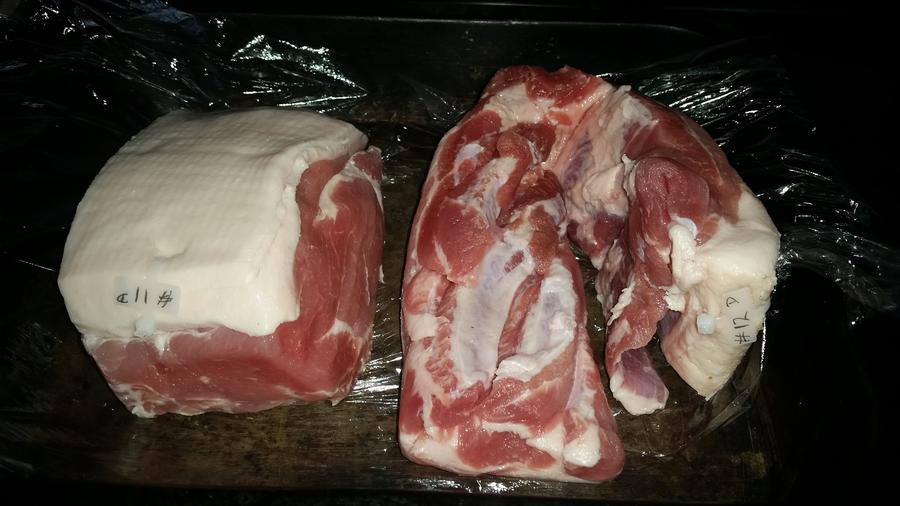
Looks like the 10% uptake rule doesn't apply...
Follow along with the video below to see how to install our site as a web app on your home screen.
Note: This feature may not be available in some browsers.

That's BS...... Someone was guessing....
The size of the molecules.... the shape of the molecules.... their polarity.... and their density.... etc. all determine the "speed" at which equilibrium takes place... the same can be seen in an expensive drink at the bar.... different separations in a drink from different booze... that's why fresh water floats on top of salt water.... cold water "sinks" and warm water "floats"...
Some molecules move fast..... some move slow...... Like the statement in overhauling bellies in a brine solution.... the salt has tendency to "sink" toward the bottom of the vat, while the sodium nitrite "tends" to float toward the top... and thus, overhauling should be done ...
The brine has to work it's way through a network of muscle tissue... The tissue acts as a filter.... molecular sieve so to speak...
" [COLOR=181818[B]]the salt has tendency to "sink" toward the bottom of the vat, while the sodium nitrite "tends" to float toward the top... and thus, overhauling should be done ... "[/COLOR]
Dave, can you provide some more detail and a link where I can get more info on this?[/B] College Chemistry was a LONG time ago but the whole bases of Diffusion is that Salt will move from an area of high concentration to one that is lower or non-existent to reach equilibrium. This rate of diffusion ( Flux ) in water will vary by the concentration, high concentration can result in ion collisions slowing the process slightly, low concentration ions move in virtually a straight line to the area of lowest concentration thus diffuse at a faster rate. Lastly heating the solution increases the speed of diffusion. Once eguilibrium is reached we have by definition no net flux or no steady movement between concentrations. However since we mix brines these processes are irrelevant. The ions of dissolved Sodium Nitrite will act in a similar manner. While flux does not have to be a steady zero once equilibrium is reached, the molecules can move within the water if for any reason the concentration changes, moving into the meat , however the Net Flux must be zero, any changes will equalize to maintain the same overall concentration, equilibrium is maintained. Is this incorrect? Thanks...JJ
http://michaeldmann.net/mann1.html


With each brine the weight increases were similar however they varied significantly between meat cuts. Both loins showed an increase in weight of ~7% whereas the bellys increased between 11.5% and 13.75%

I think that maybe it is an effect caused by the surface area of the meat that is exposed to the brine. The belly joint is thin and flat and has many ridges and troughs and so has a significantly greater surface area to absorb the brine compared to its volume than the loin. My gut feeling though (no pun intended) is that given time both will probably end up being able to absorb similar amounts of brine for any given amount of muscle - but as the loin has proportionally more muscle and less fat than the belly it may eventually even be able to absorb more brine weight-for-weight.Interesting results Wade, I would have guessed the loin would have picked up more weight then the belly. Any thoughts on the difference?
Hey Dave, we're all are stupid at times, you ain't so special :biggrin:




SmokingMeatForums.com is a community of barbecue and outdoor cooking enthusiasts dedicated to smoking meat.
© 2004-2026 SmokingMeatForums.com