March 13, 2018
UNIVERSITY PARK, Pa. — Millions of Americans will celebrate the St. Patrick's Day holiday this month with a "traditional" meal of corned beef and cabbage — but most won't pause to consider what makes the meat so distinctive or how it ended up being a tradition.
And of those relatively few who do ponder the pink color and salty tang of their brisket, many will be misled by the label on their corned beef into thinking the meat has not been cured, according to
Ed Mills, associate professor of meat science in Penn State's
College of Agricultural Sciences. But it's not a big deal, he believes.
"Many of the corned beef products you see in grocery stores these days have labels that say 'uncured,' but that's not really accurate," Mills said. "They have been cured, but the curing has occurred with nitrates and nitrites in added celery juice powder, sea salt or unrefined sugar — and not by the customary large grains of salt, accompanied by a small amount of sodium nitrite."
Mills explained that meat processors use celery juice powder, sea salt or unrefined sugar to cure the meat and make corned beef because consumers are uneasy about nitrite being linked to cancer. Many are comforted by a label that states "no nitrates or nitrites added," because they perceive that substituting celery juice powder for salt in curing results in a more healthy product.
"That's an attractive claim, but my contention is that the processors making these products should be allowed to use different terminology that draws attention to the fact that they are cured, but in a different way," Mills said. "I kind of like the term, 'naturally cured.' But the U.S. Department of Agriculture has not allowed processors to put that terminology on the labels of these products."
Still, nitrite is nitrite, Mills pointed out, and if the meat is colored pink after it has been thoroughly cooked, nitrates or nitrites have done their job, converting the natural myoglobin in beef to nitrosohemochrome. Nitrates and nitrites contribute to typical cured-meat color and flavor and reduce the risk of dangerous botulism during curing by inhibiting the growth of Clostridium botulinum spores. The curing reactions are the same whether nitrite is added as a pure crystalline salt or it comes from celery juice powder.
However, Mills maintains that it makes little difference. While he concedes that there is reason to be concerned about nitrite or nitrosamines produced by nitrite as carcinogens, he doesn't see corned beef, eaten in moderation, as a threat.
"If we look at cured meat products as a source of nitrates and nitrites, the way they are manufactured, nitrite has already reacted and for all intents and purposes is already gone by the time we consume the product. It had its function — it did its chemistry early on in the manufacturing of the meat product," he said.
"Also, the opportunity for nitrosamine production by nitrite in corned beef is very small. Some of it is bound to the myoglobin that gives the nice pink color in a cured meat product like corned beef, but when we look at foods as a source of nitrite, exposure from cured meat really is very low."
Most dietary nitrite and nitrate, Mills added, come from fruits, vegetables and alcoholic beverages. Cured meats account for less than 20 percent of dietary exposure to nitrite and nitrate.
Another common misconception about corned beef is that it is a traditional Irish food. It is not. It was adopted by Irish immigrants in the United States and later became connected to St. Patrick's Day through the mixing of cultures.
Corned beef, historians tell us, has been around for centuries and has been a staple in many cultures, including most of Europe and the Middle East. It gets its name from the "corns," or corn-kernel-sized grains of salt, originally used to cure the meat. Ireland did become known for exporting corned beef in the 17th century after British land owners brought cattle into Ireland. But the Irish people couldn't afford to eat it themselves.
Their traditional dishes used corned pork instead, and they relied heavily on nutrient-dense potatoes to survive. When large numbers of Irish immigrants came to the United States in the 18th century, they brought with them the concept of beef as a luxury. So when they found that salted beef brisket was cheap in the states, they were quick to replace their traditional "Irish bacon."
Cabbage also was readily available and affordable, and a dish combining the two became a standard for working classes across the country. As St. Patrick's Day evolved into a celebration of Irish heritage and nationality for Irish-Americans, corned beef and cabbage became a holiday tradition for consumers across the nation.
Mills, who has Irish roots — his ancestors relocated to Scotland during the potato famine and eventually made their way to the United States — has only one concern about corned beef or other cured meat products: their sodium content.
"I'm not a health professional so don't just take my word for it, but the sodium content of corned beef should be of concern to someone who has high blood pressure, whether it is cured with sodium nitrite crystals or celery juice powder and sea salt," he said. "But my family will be having corned beef and cabbage for St Patrick's Day."

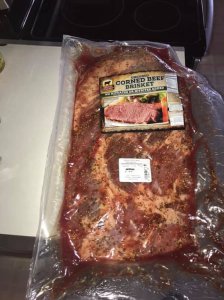 Saw this posted on Facebook. The labeling has me confused; maybe someone can enlighten me. "uncured"? "corned beef"? Isn't that an oxymoron? Uncured would make it a brisket while corned beef would be cured. No?