- Dec 28, 2013
- 2,907
- 3,113
3 new Lodge pans.
Opinions- Crisxo or Grape Seed oil for seasoning.
Thanks.
Opinions- Crisxo or Grape Seed oil for seasoning.
Thanks.
Follow along with the video below to see how to install our site as a web app on your home screen.
Note: This feature may not be available in some browsers.
I've never thought about tallow, Brian.Tallow ...
Yes. Both work the same.I've never thought about tallow, Brian.
I have a skillet that needs to get re seasoned. I'm going to try tallow.
Have you tried it with lard?
I do all my high heat cooking, griddling and seasoning with avocado oil. Amazing stuff. I buy it in bulk by the gallon from a unique hardware and misc supply store in the Mennonite area near me.Avocado oil
Template:Smoke point of cooking oils - Wikipedia
en.wikipedia.org
I hit mine with a random orbit sander. Works great if they're rough from the factory, which many are. The lathe addition sounds awesome. How do you attach it?Chris Kimball (177 Milk Street) recommends grape seed oil. I like the way it stays put on the surface.
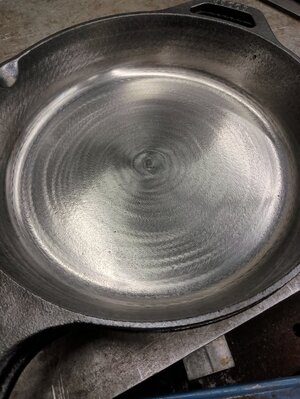
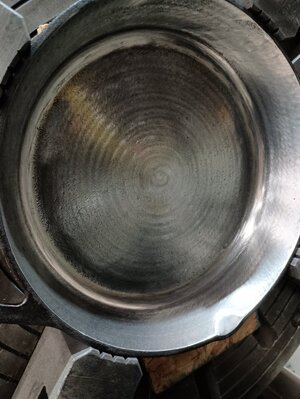
As if I needed more cast iron pans, I bought 2 new skillets last year and did the smoothing hack on them with a 4" grinder and a flap disk. Far superior to the way they arrive from the factory. Spun mine in a lathe to make them look nicer and more consistent, but on a bench would work fine too. You get all the benefits of a 100 year old pan that was sanded smooth, at the cost of a new dirt cheap one, but with a new flat bottom. More non-stick than any other cast pan I have, and I have many.
Most folks online recommend an orbital sander, I presume because they're more commonly available. I can understand the reasoning as a final finish, but given the amount of material that needs removed, a 36 grit flap wheel was a whole lot faster and plenty smooth enough for me. I didn't have but maybe 5 minutes on each pan and they were done. As you can see, the lathe is pretty big. I set it to about 30 rpm (Pretty slow) and just used it to make the job go faster and more consistent. I had to be a little aggressive in the corners because the cast was rougher there. Beforehand, I washed the pan with dawn, then dry with the air hose. That got rid of the factory oil seasoning which would make a mess when sanding. Then sanded till shiny. Wasn't worried about slight scratches, they are a whole lot smoother than the pan from the store. If they ever bother me, your orbital sander idea will clean them up and I can do that at home any time.I hit mine with a random orbit sander. Works great if they're rough from the factory, which many are. The lathe addition sounds awesome. How do you attach it?
Makes perfect sense now that you talked me through it! The monstrous lathe threw me off! You've got it down to a science, extraordinary results. Great process.Most folks online recommend an orbital sander, I presume because they're more commonly available. I can understand the reasoning as a final finish, but given the amount of material that needs removed, a 36 grit flap wheel was a whole lot faster and plenty smooth enough for me. I didn't have but maybe 5 minutes on each pan and they were done. As you can see, the lathe is pretty big. I set it to about 30 rpm (Pretty slow) and just used it to make the job go faster and more consistent. I had to be a little aggressive in the corners because the cast was rougher there. Beforehand, I washed the pan with dawn, then dry with the air hose. That got rid of the factory oil seasoning which would make a mess when sanding. Then sanded till shiny. Wasn't worried about slight scratches, they are a whole lot smoother than the pan from the store. If they ever bother me, your orbital sander idea will clean them up and I can do that at home any time.
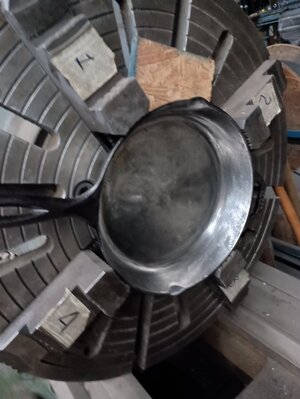
As to how it's held in the lathe, there's a pic of that. The jaws were a little deeper than the pan, so I stuck that hunk of osb behind the pan as a spacer on the chuck face. Now the pan was close to the edge of the jaw so I didn't grind that. That wood got removed before spinning it. And no need to indicate the thing to machine it. I just eyeballed it for being centered enough. The tips of the jaws just grabbed the edge of the pan. Again, turning very slow, just enough that it kept it moving for me and I held the 4" grinder still as the pan spun.
Now if your question was about how the chuck itself holds it, (forgive me if this wasn't your question), that's a 4 jaw chuck. You can clearly see 4 jaws in the pic. A 4 jaw differs from a 3 or 6 jaw in that each jaw is moved independently. They're not shown in the pic, but each of those jaws has an acme thread lead screw which moves it to loosen / tighten. A square key (T wrench) goes in those lead screws at the periphery of the chuck to adjust the jaws in / out, one at a time. A 4 jaw is for irregular parts that otherwise can't be held in a 3 jaw or 6 jaw. In those, one similar key rotates a scroll which adjusts all the jaws simultaneously. Those hold round parts mostly, and easily centered (more or less).