I'm sorry and apologize I didn't get it.... It wasn't clear to me what your question was...
Thickness and fat content are the deciding factors when cooking meats in a sous vide....
AND the shape of the meat cut has a lot to do with cooking time...
That being said, Baldwin has noted, in his charts several factors are combined when determining the cooking times...
Worst case scenarios are considered and are "added in" to the cooking times.... This simplifies the cooking process by having fewer variables...
I do not know how many variables there are, that would have had to been considered... Those variables would have been evident to Baldwin, during his development of the tables..
Below are "HEATING TIME" charts from different starting temperatures... to 1 or 2 degrees below the set temp...
From looking at Baldwins stuff, looks like the last few degrees takes a long time to achieve... So, it would appear to get meats to temp faster, make your set point 3 or 4 degrees higher than the final temperature you are wanting.. if the final temp is not that critical to you....
It's "my understanding"... these charts are used for food that previously has been pasteurized or reheating food for consumption, if you are healthy and your immune system is not compromised... Baldwin is not clear on this, that I have found...
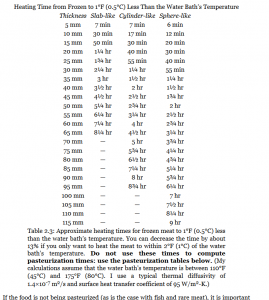
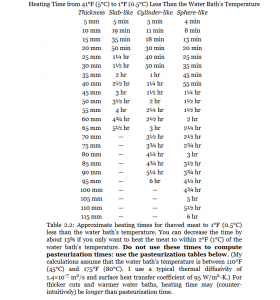
Cooking time for poultry, to me, FAT is an example of one variable that contributes to pasteurization time...
Evidently, the heat transfer through fat is a big deal by looking at the Gov't poultry pasteurization table...
Baldwin took the time to compute the worst case scenario in his poultry table ...
How you would determine the fat content of poultry is beyond me...
.......Baldwin's table.......
........Gov't poultry pasteurization table......
Cooking meats by Baldwin's tables......
It appears Baldwin has used the "worst case" scenario in these tables to include "the shape of the meat cut" as he doesn't differentiate "Slab, Cylinder or Sphere"..... making the cooking process easier to determine....
Now, let me address the recipes you mentioned in your post #11......
Baldwin's tables above are minimum times and temperatures to achieve pasteurization of specific meat thickness, shape and fat... Those tables achieve perfectly safe cuts of meat to eat, well below the final temperatures the USDA notes in some of it's publications... You end up with a moist cut of meat because you haven't cooked it to death...
The recipes you noted are cooked at much higher temperatures for many hours or days, exceeding the pasteurization time Baldwin has noted..
Those specific recipes you noted, go WAY beyond pasteurization and are used for meat tenderness to break down collagen and meat fibers etc... If you notice the temperatures they are cooked at, they exceed the pasteurization tables temperatures..
Again, I apologize for my ignorance and hope this covers your concerns...
I am here to help... If I can further clarify anything I may have missed................
Dave
..