Wet Cured Pork Leg/Ham Browning

  • Some of the links on this forum allow SMF, at no cost to you, to earn a small commission when you click through and make a purchase. Let me know if you have any questions about this.
SmokingMeatForums.com is reader supported and as an Amazon Associate, we may earn commissions from qualifying purchases.

Zander

Newbie
Original poster
Feb 7, 2018
2
0
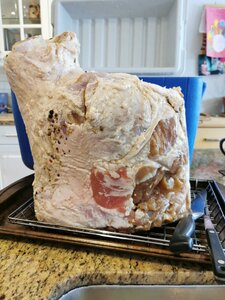
I've had a pork leg completely submersed in a cooler for 15 days in a brine (cure #1); was also injected originally.

Just removed it and noticed portions appear to be "not yet cured" as you can see from the image.. firm pink in one area, spongy grey in another.

Doesn't smell bad or rotted.

I've since learned that brine needs to be at 50-55 degree range for bacteria to do their work. Pretty sure this is the mistake as I put the cooler in my freezing garage. so the brine was likely at 40-45 degrees for the first 5 days and closer to 30-35 degrees for the last 10 days as it got cooler outside...

The question I have is (assuming the meat is not spoiled); should I cook it ASAP, or can I add another 5-10 days in the wet cure (this time at correct temps?)

Thx for any advice in advance.
 

Attachments

  • IMG_20210131_102219.jpg
    IMG_20210131_102219.jpg
    161.5 KB · Views: 37
Can you post your brine recipe, I may be wrong but I think your temp should be 36 to 40, did you heat your brine at all. Did you inject. The brown might be where it was in contact with your bucket.
 
First a few questions:
(1)Weight of ham?
(2) How much water?
(3)How much Cure#1
(4) How much was injected?

Your curing temperature was ok. The higher temps you mention would be for fermentation.
Was the grey part in the picture the part of the ham that was touching the bottom of the cooler?
In any case; incomplete cure would be in the center of the leg. Not the external part of the muscle. Spoilage is most likely to happen along the bone.

Cut a 1-2 inch thick slice off the brown part. It'll probably be nice a pink underneath.
 
36 to 40 is the correct temp .
The red comes from being in contact with another surface . The brown is normal , in a normal situation .
I have no input on safe or not .
 
Last edited:
  • Like
Reactions: DanMcG and dr k
Sounds like it may be perfectly fine; thanks for confirming correct temp;

Grey part in picture was section not touching the cooler. The pink part was in contact with the bottom of the cooler. If I cut in I doo see pink however without really cutting in, hard to tell "how pink" or "if throughout".

Leg was 22Lb
Brine boiled; 3 gallon water, 2 1/4 cup salt, 3 TB cure #1; +spices. Injection 15%
 
You are on the low ragged edge on the cure #1. salt is fine. I think you are ok but right at the minimum. Next time weigh your salt and the cure then add as a percentage to the meat and water.. Don’t be afraid to add 0.5-1.0% sugar to level out the salt taste.
 
  • Like
Reactions: dr k
3 gal water x 8.34lbs/gal+22lbs of meat at 1.13 grams/lb cure #1=53grams of cure #1. Then 1% sugar, 2% salt or so. You can back out the 93.75% salt/gram of cure #1 the get the true 2% salt with 6.25% nitrite in cure #1. A heaping Tbsp of is 17 to 21 grams so if leveled then a little low but should be ok. I'd ad cure to dissolve after the brine cools , since heat breaks down the cure #1.
 
  • Like
Reactions: chopsaw
You are on the low ragged edge on the cure #1
Agreed; this is on the low side.
At 15% injection; the meat is at 40ppm NaNO2.
However, the OP is using the same concentration of cure that Pop’s Famous Brine calls for.


...since heat breaks down the cure #1.
This is a myth.
I don’t boil my brine because it is not necessary and because I don’t want to wait for it to cool; but it is certainly safe to do so.
 
This is a myth.
I don’t boil my brine because it is not necessary and because I don’t want to wait for it to cool; but it is certainly safe to do so.
daveomak daveomak and chef jimmyj chef jimmyj . I realize cured hams that are raw go in and out of cold smoke and the refer over weeks to get the color and smoke penetration being raw and smoke keeps penetrating unlike warm, hot smoking it after 145ish when the meat coagulates and penetration stops and your left with just adding smoke to the bark. Like raw, cured, packaged belly bacon has a six week refer life. I was under the impression that cooking cured meats breaks down nitrite NO2 or Ntiric Oxide NO being heated. I guess nitrite loses an oxygen atom breaking down to Nitric Oxide during curing and is nitrogen in this form broken down during heating the meat but adding Nitrite to boiling water for the curing brine then ok ? I thought baking belly bacon in the oven over twenty minutes vs flash frying high temp quickly also produces less Nitrosamines. Do my raw cured bone in loin chops that I bring in and out of cold smoke and the refer have a month or six weeks in the refer and if cooked straight out of the cure would that be a shorter duration in the refer vs cured raw. I prefer to refer the chops because freezing can change the texture.
 
With Whole Muscle, Ham, Bacon, etc. Cure is added for Flavor and Color. It also protects Fat from going Rancid. Cure only protects against C Botulinum, Salmonella and Listeria, it has no impact or little effect on Spoilage Bacteria and Refer shelf life. Salt content, level of Hydration and Storage Temp, determines how long it will last in the refer.
Commercially processed meats, Cured or Fresh, have 6 week shelf lives because of handling under Sanitary conditions and Regulated HACCP programs, along with Vac-Pack or Modified Atmosphere Packaging. Once your Butcher or Meat Deptment Flunkies get their FILTHY PAWS on your meat...You got 3 to 5 days to use or freeze. Even " In House " Cured and Smoked Bacon, etc, only get around 10 days days before Spoilage Bacterial degrades the product...JJ
 
  • Like
Reactions: wade
Damn! Wish I could get more than 10 days in the refer after curing those raw, bone in, 12 hour cold smoked loin chops with 1% sugar 2% salt in the 35 degree refer they cut to 2" with the band saw before going into the wet 156 ppm curing brine . I guess if I get a whole boneless pork loin for CB and cure it, then cold smoke whole, I can bring it in and out of cold smoke/refer like a three week cold smoked raw ham. to get the color, flavor and refer storage duration!? If it's spoilage bacteria then the nose will tell. Still trying to find out what cooking cured meat does to the cure vs dumping cure into a simmering wet brine? I thought cooking cured meat reduces the nitrite or nitric oxide level in it. So heat is heat. why not reduce the efficacy in boiling nitrite?
 
Still trying to find out what cooking cured meat does to the cure vs dumping cure into a simmering wet brine?

The iron-containing heme group in myoglobin reduces the NO2- ion forming nitrosomyoglobin. The rate of the reaction is dependent on temperature. Upon cooking, the protein denatures and forms nitrosylhemochromogen. Again, the reaction rate depends on temperature.

What chemical process would have to take place between H2O and NO2- to reduce the ion? H2O becomes H2O2? That is not a favorable reaction since water is stable and hydrogen peroxide is a strong oxidizer. H2O wants to stay as H2O. H2O2 wants to become H2O.

If anything NO2- wants to be oxidized to NO3-. But there isn't enough dissolved O2 in water to meaningfully effect the NO2- concentration in the brine. In nature, ground and surface water have more NO3- than NO2- because the water cycle maintains dissolved O2 levels.
 
  • Like
Reactions: chef jimmyj
The iron-containing heme group in myoglobin reduces the NO2- ion forming nitrosomyoglobin. The rate of the reaction is dependent on temperature. Upon cooking, the protein denatures and forms nitrosylhemochromogen. Again, the reaction rate depends on temperature.

What chemical process would have to take place between H2O and NO2- to reduce the ion? H2O becomes H2O2? That is not a favorable reaction since water is stable and hydrogen peroxide is a strong oxidizer. H2O wants to stay as H2O. H2O2 wants to become H2O.

If anything NO2- wants to be oxidized to NO3-. But there isn't enough dissolved O2 in water to meaningfully effect the NO2- concentration in the brine. In nature, ground and surface water have more NO3- than NO2- because the water cycle maintains dissolved O2 levels.
Ok. so once again, and I wish I heard from daveomak daveomak . WTF is my refer life on my GD chops I Fing mentioned above. Time to bail and find a site that can get me to my answer. help everyone please now!
 
  • Wow
Reactions: DanMcG
Agreed; this is on the low side.
At 15% injection; the meat is at 40ppm NaNO2.
However, the OP is using the same concentration of cure that Pop’s Famous Brine calls for.
Pop’s original brine called for 3.8 oz. He reduced that later for low salt and only using as much cure as was needed for the job. He posted a picture of the DQ cure package that stated the 3.8oz. Per gallon.
Problem is, can anyone quantify the actual uptake of the meat from a given brine? How much cure is in the meat after 3 days, 10 days or 2 weeks? Without a laboratory you can’t know. Brining meat is an effective but old way of curing whole muscle meats. There are much more precise methods today that should be used. In my opinion.
 
  • Like
Reactions: DanMcG
Ok. so once again, and I wish I heard from daveomak daveomak . WTF is my refer life on my GD chops I Fing mentioned above. Time to bail and find a site that can get me to my answer. help everyone please now!

What are you looking for, someone to say, " They will last a Month or Two, no Problem."!?

There is just no Definitive Answer without knowing the meat condition EVERY MINUTE from Slaughter to Refrigerator!

How was the meat handled at the Slaughter/Processor?
Do they Follow their HACCP Program?
Any Gut Contamination during processing?
How Sanitary are the workers and Facility?
Do they Pass Inspections with a Score above 90, or Pay Off the Inspector to Overlook, certain difficiencies?
How was it handled during transportation and storage?
Any Refer breakdowns, or Pallets sitting on a Loading Dock waiting to be moved into refigeration?
How was it handed at the Grocery Store?
Did you cut your chops from a Vac-Packed Whole Loin, kept Cold or one that road around in a Customers Cart, then left in the Bread Isle until an employee found it and put the meat back in the Case?
Was the Pork in the Case kept at less than 36°F?
Did the employees overfill the Case, the Porkloins on the top sitting at Room Temp?

Unless you can Answer ALL of these Questions....AND....Plan on storing your Chops in a Dedicated 29 to 32°F Refer that is rarely opened.
Has NO other source of Contamination like other Food, Leftovers, Raw Meats, Etc, in the refer with them...AND...not questioning work habits but, " You " handled them under extremely Sanitary Conditions during the Cutting on a Sanitized Saw, and maintained Sanitary Conditions during storage sessions. Including further preparation on Sanitary work surface, Sanitary tools and self, with no coughs, sneezes, inadvertant touching of your hair, skin or clothes, or anything that may be contaminated in the work space, including during Curing and during Smoking.
.Then...
You have 5 Days maybe up to 10, to eat or Freeze them.

Not Dave Omak, anyone at SMF or other Smoking Sites, the staff of the CDC, FDA, USDA or their Boss, Sonny Perdue, Secretary of the Department of Agriculture, can give you a more definitive answer.

I'm Sorry to say, the Above is the Reality of Meat and Food Handling. I worked in Grocery Stores for several years and have Seen it All. The most Conscientious and Sanitation trained employees make mistakes.
I was trained in Food Safety to become a Pro Chef and later became a Certified ServSafe Instructor, teaching Food Sanitation and Safety to Hundreds of Food Service Workers and future Chefs. We all have jumped thru hoops to keep Sanitary Conditions and still Bacterial Contamination happens and Food Spoils.

You want 4 to 6 weeks of Storage? Raise, Slaughter, Butcher and Process a Pig into Chops. All the time Wearing a Hazmat Suit in a 36°F Refrigerated or ambiently Cold, work space. This needs to be near Hospital Sanitary, an every step from Kill, to Cutting to Curing and Smoking, Everything, must be done Perfectly with extremely little to no Bacterial contamination, including Vac-Packing, before storing in your home refer. Other than all that....
5 to 10 days is the the Best answer I or ANYONE educated in Food Safety can give...JJ
 
  • Like
Reactions: DanMcG
I've since learned that brine needs to be at 50-55 degree range for bacteria to do their work. Pretty sure this is the mistake as I put the cooler in my freezing garage. so the brine was likely at 40-45 degrees for the first 5 days and closer to 30-35 degrees for the last 10 days as it got cooler outside...

Where did you get that info ???????

I think you are confusing cure#2 to do it's magic... There are certain bacteria that are needed to convert nitrate to nitrite... They need ~50-55F range to multiply..
Nitrite is a "quick" and "short term" cure, dissipating over time and thus loses it effectiveness... Some recipes call for adding nitrite in steps to prolong the effectiveness... A temperature range of ~34-38F is necessary for nitrite and controlling bacteria that are detrimental to food spoilage and health...
Salt is the second part of controlling spoilage and moisture the third....
From what I've read, 2.75% salt along with 0.25% cure#1, and reducing the moisture in the meat is minimum necessary for long term storage...
Initial temps of ~34-38F for several weeks to lower the Aw is the start... Maybe even adding another "dusting" of nitrite after a week or so...
Then the meat may be stored at 50-55F with humidity control of ~75-80% to reduce the moisture further... 50-55F is necessary to SLOW the bacterial growth... meanwhile the salt level % is increasing as moisture leaves the meat...
Now the bacteria should be sufficient to convert nitrate to nitrite to further protect from botulism bacteria..
This process is a delicate dance... moisture, nitrate, nitrite, salt and temperature.... It's a "symbiotic" relationship that balance is so important....

Too often folks read one part of a method and add it to a different method... Thinking curing is curing.... what can go wrong... Well, follow one proven method and don't substitute...

2021-02-01.png
 
  • Like
Reactions: PolishDeli
Pop’s original brine called for 3.8 oz


The recipe calls for 1 oz. up to 3.84oz (advises against 3.84 oz for meat texture reasons.)

""Pop's Curing Brine" of 1 oz. (heaping tablespoon - a level tablespoon of curing salt is .88 of an oz.. but a heaping tablespoon is 1 oz.)) of curing salt to 1 gallon of water."

The OP used 3TB cure#1 in 3gal of water.


can anyone quantify the actual uptake of the meat from a given brine?


You can do alright in your kitchen with only a scale and a nitrite test kit for fish tanks.

Before curing:
(1) Weigh the meat.
(2) Measure the nitrite concentration in the brine.

Repeat (1) and (2) as often as you like during the curing process, and again once curing is complete.

The difference in weight is the pickup.
If there if a decrease in the brine's NaNO2 concentration; you’ve moved toward equilibrium.
I’ve done these measurements a few times and have never detected a change in concentration.
I only use the pick-up equation. I pump ~10%; after that, the weight doesn't change much during curing.
The time scales needed to achieve equilibrium are much longer than our standard curing times.
 
SmokingMeatForums.com is reader supported and as an Amazon Associate, we may earn commissions from qualifying purchases.

Latest posts

Hot Threads

Clicky