
Up_In_Smoke
Smoking Fanatic
I don't understand the whole "no seed oil" thingy.
Is any of that based on actual science??
Is any of that based on actual science??
Follow along with the video below to see how to install our site as a web app on your home screen.
Note: This feature may not be available in some browsers.

Yes. Real actual science. I have a very strong background in organic chemistry. I understand the science. Here are some cliff notes for anyone interested:I don't understand the whole "no seed oil" thingy.
Is any of that based on actual science??
Thank you for the detailed explanations.Yes. Real actual science. I have a very strong background in organic chemistry. I understand the science. Here are some cliff notes for anyone interested: snip

You bieng our resident microbiologistFYI, it takes 3-4 years to rid the seed oils from your body and get your omega 6: omega 3 ratio back in line where it should be...and that is if you stop eating all seed oils today, and never touch the stuff again. Anyone wanting to go down this rabbit hole should look up and research how Criso was invented and marketed to the public back before there was such a thing as 'food regulations'.
 , what is your opinion of flax seed oil as a supplement for Omega 3?
I'd like to know more about this as well. My wife is diabetic and I'm pre-diabetic, therefore we've been eating low carb with occasional small portions of potatoes, pasta, etc.You bieng our resident microbiologist
Also, on the carbs discussion, what do you think about resistant starch? I have read for some time that preparing and refrigerating starches like pasta, rice and beans before eating converts a lot of the "sweet" carbs in to resistant carbs which is digested differently, and actually beneficial for gut health.
I ran across this in a BBC article I stumbled on somehow. The author regularly ate at a nearby Italian place (like 5 times a week) and wondered why he didn't get fat eating pasta, essentially all week long. He also wondered how they could get a plate to his table in less time than it takes to typically boil most pastas. When he asked the server, she told him all the pasta is boiled al dente the day before, then portioned and refrigerated. When ordered the pasta is dropped in boiling water for about a minute, drained and served.
He got the staff to agree to an experiment, with half eating the pre-boiled pasta, and the other half eating freshly boiled pasta, then started monitoring blood sugar levels (by what method I cant recall). Those eating the pre-boiled and refrigerated overnight pasta had a much lower blood sugar spike that lasted for a shorter duration.
Thank you for the detailed explanations.
So... Olive oil??
Yes, this is true. Some starches become resistant starches when you cool them after they are cooked. And the short reheat makes then even more so, as long as the temp of the starch does not return to above around 180*F (I think?) Just warm them to 140-150ish. And never in the microwave. That won't work.You bieng our resident microbiologist
Also, on the carbs discussion, what do you think about resistant starch? I have read for some time that preparing and refrigerating starches like pasta, rice and beans before eating converts a lot of the "sweet" carbs in to resistant carbs which is digested differently, and actually beneficial for gut health.
I ran across this in a BBC article I stumbled on somehow. The author regularly ate at a nearby Italian place (like 5 times a week) and wondered why he didn't get fat eating pasta, essentially all week long. He also wondered how they could get a plate to his table in less time than it takes to typically boil most pastas. When he asked the server, she told him all the pasta is boiled al dente the day before, then portioned and refrigerated. When ordered the pasta is dropped in boiling water for about a minute, drained and served.
He got the staff to agree to an experiment, with half eating the pre-boiled pasta, and the other half eating freshly boiled pasta, then started monitoring blood sugar levels (by what method I cant recall). Those eating the pre-boiled and refrigerated overnight pasta had a much lower blood sugar spike that lasted for a shorter duration.
what is your opinion of flax seed oil as a supplement for Omega 3?

Yes, they did get it right! That is the bariatric food pyramid right there. Protein, protein, and more protein, plus veggies--no sugars and high starch food.I am talking about getting the Food Pyramid Right!
The new guidelines recommend adults consume 1.2 to 1.6 grams of protein per kilogram of body weight per day. This is a substantial increase compared with the old baseline recommendation of roughly 0.8 grams per kilogram.
View attachment 729956
RG
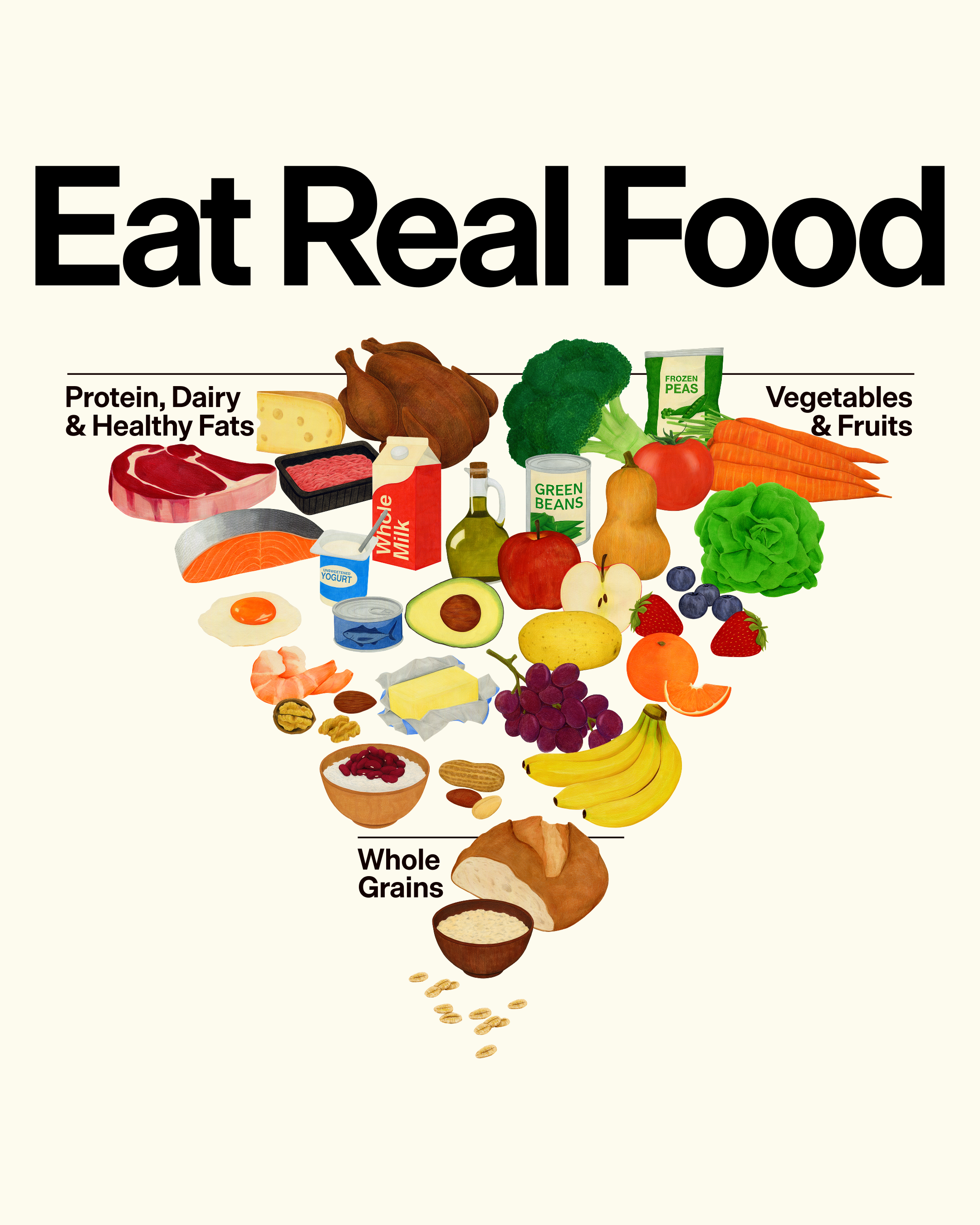
WHAT THEY ARE SAYING: Trump Administration Puts Real Food First in Dietary Guidelines
The Trump Administration’s updated Dietary Guidelines represent the most significant reset of federal nutrition policy in decades. By prioritizing realwww.whitehouse.gov
I did read that potatoes may not remain "resistant starch" when reheated, and Inda here brings up heating methods and max reheating temps. So, more research may be needed. It doesn't seem like a priority in the food science field though...I mean, how could they sell you drugs if simply dong this could reduce blood sugar!?I'd like to know more about this as well. My wife is diabetic and I'm pre-diabetic, therefore we've been eating low carb with occasional small portions of potatoes, pasta, etc.
And that was the biggest thing the release of this inverted pyramid came with, telling us to eat whole foods, not processed foods. Some of the restaurant food out there is fine (I dont consider fast food a "restaurant"), but many have started to use Sysco Systems and U.S. Foods, etc. as a supplier. It's why so many places that used to not be bad are now all tasting the same...mediocre. It's all packaged, pre-cooked, portioned, etc..I have taken a new stance a few years ago....there is no food you can cook at home that comes anywhere near as harmful to you as what you get in a restaurant. I think someone should sue the fast food industry...because there is no food in that garbage they sell. Every restaurant I have been roped into going to the last couple of years is all cooked by chef Mike-row-wave. processed food, reheated and served as fresh. Unless you go to a place where you see the food cooked-I'll bet it came out of a box.
My next beef is with the school system. What the hell happened to feeding your kid breakfast before they go to school? No offence to Mrs Obama, but really. A teenager cannot function on an 80 calorie yogurt cup and an apple.

I'm confused on "seed oil" is bad for you but one of the most heavily GMO products as rape (Canola) seed oil is ok.There is one other oil that is acceptable, but it is hard to find. And that is cold first pressed canola oil. Made like olive oil, but it is Canola. It is pricey thought. All other Canola oil is no good.
Eating seeds that have oil= goodI'm confused on "seed oil" is bad for you but one of the most heavily GMO products as rape (Canola) seed oil is ok.
So, I asked Grok:You bieng our resident microbiologist
Also, on the carbs discussion, what do you think about resistant starch? I have read for some time that preparing and refrigerating starches like pasta, rice and beans before eating converts a lot of the "sweet" carbs in to resistant carbs which is digested differently, and actually beneficial for gut health.
I ran across this in a BBC article I stumbled on somehow. The author regularly ate at a nearby Italian place (like 5 times a week) and wondered why he didn't get fat eating pasta, essentially all week long. He also wondered how they could get a plate to his table in less time than it takes to typically boil most pastas. When he asked the server, she told him all the pasta is boiled al dente the day before, then portioned and refrigerated. When ordered the pasta is dropped in boiling water for about a minute, drained and served.
He got the staff to agree to an experiment, with half eating the pre-boiled pasta, and the other half eating freshly boiled pasta, then started monitoring blood sugar levels (by what method I cant recall). Those eating the pre-boiled and refrigerated overnight pasta had a much lower blood sugar spike that lasted for a shorter duration.



SmokingMeatForums.com is a community of barbecue and outdoor cooking enthusiasts dedicated to smoking meat.
© 2004-2026 SmokingMeatForums.com


