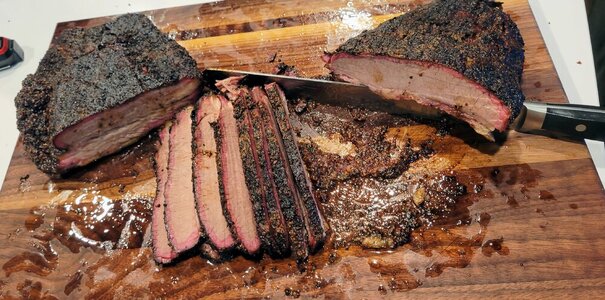
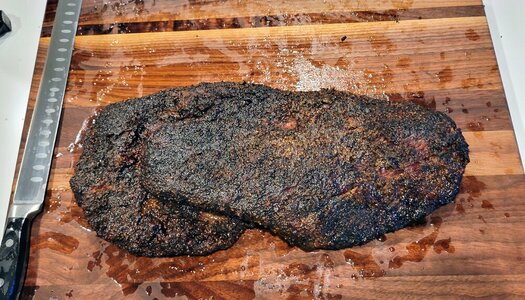
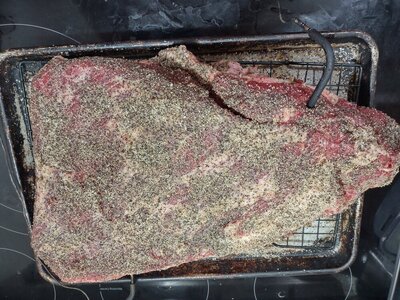
Thanks for the feedback. I think I will give the no wrap a try next time. What temp do you run your pit at? And do you spritz or use a water pan?
I run an MES and no water pan or spritzing at all. The MES holds moisture super well so it's not needed. Stick burners and pellet grills may have to do something with a water pan and moisture management.
I run it at a dead on 275F smoker temp. My MES is rewired and uses a PID controller so it hits and holds dead on!
Now, I have started a new approach (about 3-4 briskets done this new way) that is showing promising results but I need to do like another 2 briskets before I feel it is consistent and repeatable.
I've noticed that SOMETIMES I can get a little bit too barky/crusty on some outer parts of my flat muscle when doing my unwrapped briskets. Think like a 2 inch spot here, a 2 inch spot there, but never like a whole section. Just splotches.
It's not bad and not every time, but I've been experimenting to consistently eliminate those spots.
This new promising approach is simply turning the brisket fat side down towards the heat source (not a new idea) AND taking plenty of trimmed fat and laying on top of the muscle side of the flat muscle (this is the new trick).
Having the fat towards the heat source protects the meat from getting too crusty or burning up because the fat takes the brunt of the heat AND since it's fat it has all the grease and juices right there for the meat under the fat.
I took that concept and just started laying trimmed fat on the meat side around the edges of the flat and along the flat where there is no Point muscle on the opposite side. When the flat and point come together there is a layer of fat between them that helps the flat muscle so it has more protection there with fat, point, fat, then flat muscle.
Where the other portion of the flat is is just fat then flat muscle.
So now I have this extra layer of grease, juices, and heat protection when I am laying this trimmed fat on top of the muscle side of the flat!
That fat renders and shrivels up into beef cracklings and shrivels up(my buddy is now in love with eating those pieces of beef fat cracklins lol).
It does NOT prevent color or bark but instead seems to be ensuring that I am not getting any extra crusty/barky spots. So far results seem good!
I think another 2-3 briskets done this way will give me a reliable idea on how much or how little fat to meat coverage I need when laying the fat on the muscle side of the flat of the brisket!
Just an FYI, I do about 1 brisket a month since I live in brisket country and sales happen about every 2 months or so on brisket.
Anyhow I'm rambling now, but I hope this gives you an idea of how much brisket cooking and tweaking I go through when needed :D