Lol! I know. I don't believe I've seen a board like this before. The effect is really interesting.I was wondering why I didn't see the dark pieces on the back side...

Ok, thanks! The fence on the jointer was slightly out of 90 degrees. Which caused a slight cup on my glue ups. Corrected most of it while planing. There is still a very slight cup. If you didn't have a straight edge on it. I doubt you'd notice it.A new thing seems to be " picture framed " boards . Double stacked face grain center sections with an edge grain frame around the outside to hide the seam and highlight the center .
Do the same with end grain center , and edge grain frame .
I'm not seeing what your calling out on the joints , but I'm gonna send you a setup I do for all my glue ups on a table saw . Works great , especially on shorter lengths .
That sounds interesting. Might give that a go as well.A new thing seems to be " picture framed " boards . Double stacked face grain center sections with an edge grain frame around the outside to hide the seam and highlight the center .
They overlap. I'm not sure how the other layer being 90 degrees could be stronger. More joints. I really don't think the results would be appealing visually speaking. Might even be using more wood. IMHO.Steve, that is actually an excellent idea. As long as the joints in the top and bottom layer don't align you gain added strength by gluing the two layers of thinner boards together.
Plus you can use thinner lumber and avoid the premium some places charge for the thicker stuff.
An even stronger board could be made by turning the layers at 90 degrees to each other.
Because of the grain direction . That's how laminated sheet goods are made ( plywood ) .not sure how the other layer being 90 degrees could be stronger.
Understand. Just didn't think it would be useful on a cutting board. Or pleasing to the eye.Because of the grain direction . That's how laminated sheet goods are made ( plywood ) .
Not needed on a cutting board , but a legit comment on strength .
Looks like an oops ! Probably how the picture framed boards came about . Someone fixing their mistake .Or pleasing to the eye.
Could be. I found one that I'm going to try at some point.Looks like an oops ! Probably how the picture framed boards came about . Someone fixing their mistake .
Hey Rich,Tray and bowl bottom cutting bit . Template , and an oversize base .
View attachment 728608
View attachment 728607
I use it to do finger grabs , but easily adapted to do a prep tray .
Just have to have a template that matches the size of the tray .
View attachment 728606
I bought them to do these trays .
View attachment 728612
View attachment 728610
View attachment 728611
It also makes sure the glued up board remains flat.Because of the grain direction . That's how laminated sheet goods are made ( plywood ) .
Not needed on a cutting board , but a legit comment on strength .
My boards are anywhere from 3/4 to 1 3/4 " thick. This board was customer driven. But. Each piece is 1/2"thick. 1"total. None of my boards ever cupped from the wood themselves. The key is using good quality. Properly kiln dried wood. And properly treat the finished piece to prevent moisture from getting into the wood. And proper care. When you start making large, table top pieces. Then extra measures are needed.It also makes sure the glued up board remains flat.
When gluing up panels with only one layer they have a tendency to cup. They do so especially if you do not alternate the grain direction, relative to the diameter of the tree, from piece to piece. The thinner the panels, and the wider the individual pieces, the more likely to cup. The other way is to make two layers at 90 degrees to each other like plywood.
Two layers, oriented either way, virtually eliminate splitting of the cutting board, and glue line failure, down the road, however when at 90 degrees it's a superior product from a construction standpoint. Esthetics are a different consideration.
About 50 % . Try it on a test piece . Multiple shallow cuts combined with the speed .How fast are you spinning the bowl bit? The one I got 1 1/8"
Ok. Thanks. I was thinking around that speed. Just wanted to be sure.About 50 % . Try it on a test piece . Multiple shallow cuts combined with the speed .
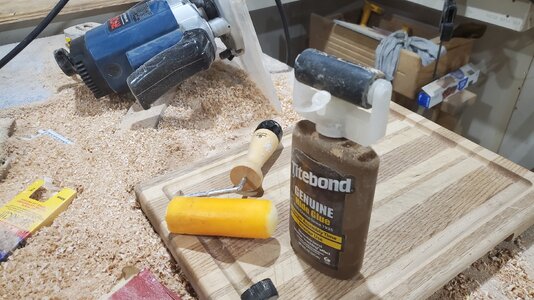
Me too. Though. I'll get III if the price is good.Todays glues are far superior to glues of the past . On those large glue up , I use Titebond 2 , and nothing else . You could take them from a heated house , to out in the cold with no ill effects .
Because they can expand and contract over / along the end grain .