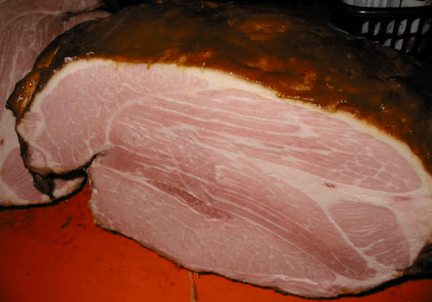
Follow Dizzy Pig co-founder Mike Kerslake as he transforms a whole pork leg roast into flavorful home cured ham. Make your own homemade ham today.

dizzypigbbq.com
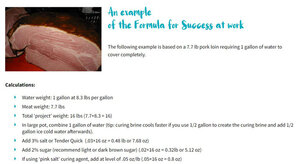
The page you linked to contained a link to 'Formula to Success' which had a sample calculation for the TQ brine mentioning 3%. A snip is below.
TQ is 0.5% nitrite......
Cure#1 is 6.25% nitrite.....
To attain the 156 Ppm nitrite the USDA recommends, 6.25% / 0.5% = 12.5 X's the Cure#1 amount is necessary....
So, multiply 1 tsp per 5#'s comes up with 12.5 tsp. per 5#'s pounds or ~4 1/8 TBS per 5#'s..
At 5.5 grams per tsp. , the weight of Cure#1 and TQ, 5.5 x12.5 = ~69 grams TQ per 5#'s..
Thank you Dave.
So with that we see that per volume, TQ has roughly 1/12th the amount of nitrite as does same volume of cure #1.
If one tsp. Cure #1 will impart 156ppm nitrite to 5# meat, then one tsp. TQ will impart 12.48ppm nitrite to 5# meat.
156/12.5= 12.48
I ran the numbers using the Dizzy Pig calculation example against Dave's calculations which concluded that the amount of TQ in
a wet curing brine is equal to ~12X the amount of Cure #1 when all weights remain the same. In this case 16# total weight, which is 7.26 kilograms total weight.
The key metrics are:
18.15 grams of Cure #1 would be needed using the standard 0.25%.
12 X 18.15 grams is 217.8 grams, the amount of TQ needed per Dave's calcs**
217.8 grams is 7.68 ounces
The Dizzy Pig calculation shows 7.68 ounces of TQ.
** EDIT - Dave's calculation came up with
12.5 X the amount of Cure #1, (not 12 as shown above) this makes the amount 226.9 grams of TQ. This is only 5% higher than the Dizzy Pig recipe.
I noticed a typo: '16 oz' should be '16 lb' in lines 5, 6 and 7. but here is a snip from the curing page.
Thanks everyone, not only did this discussion solve a puzzle I could not.... it reinforced the fact that sometimes, accurate things are posted online.

to Reg and Mike at Dizzy Pig. Will this make me switch from using Cure #1 to TQ in a wet curing brine.... probably not. But it shows that science is the process that takes us from confusion to understanding whether a process is reliable or not.
3% being the magic minimum amount of salt to hang meat and cure it to keep all the bacteria "dead"... Morton's knew what it was doing, way back, when refrigeration was not available to most folks so they could safely preserve their meat...
Makes perfect sense, but I'm glad we have refrigeration.