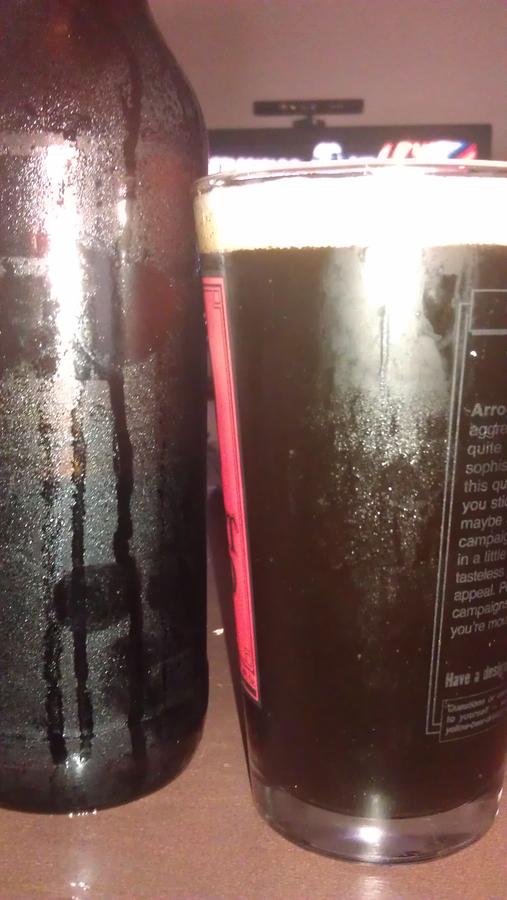
First homebrew. Nut Brown Ale (Updated B-View Finally)

  • Some of the links on this forum allow SMF, at no cost to you, to earn a small commission when you click through and make a purchase. Let me know if you have any questions about this.
SmokingMeatForums.com is reader supported and as an Amazon Associate, we may earn commissions from qualifying purchases.
Finally added pics. sorry it took so long. Been bottled about 3 weeks now and Im going to be putting some bottles in the fridge for a week till my brother gets here. Really looking forward to this.
 
Ok Ill get a pic of the first bottle up after work. Can't upload pics from here. After about 4 days in the fridge I tried one. Flavor was good however I beleive that something must have gone wrong in the bottle conditioning stage as there isn't much carbonation. I get a good initial head and then the retention is about on par for a brown ale however my wife and I feel it is somewhat flat. Iv still got about half the brew sitting out and i gave those bottles a little shake to see if that might wake some yeast up to finish the job. any suggestions? Also beer is cloudy but I expected that since it had only been in the fridge a couple of days.
 
(First, brew another batch or two. This is to get your pipeline filled so that you will eventually have enough beers to drink while the newer ones are fermenting and conditioning.)

Swirling (aka rousing) the yeast was a good idea.  Good job.

Next, try to take the bottles and warm them up for another week or two.  A good place is to put them on top of the fridge.  The warm air comes off the back coils and out over the top of the fridge.  The yeast love it up there.  Unlike primary fermentation, you don't have to worry about bottle conditioning too warm.  There is not enough sugar for the yeast to produce off flavors at this point. 

Also, if you have had the bottles on the concrete floor of your basement during conditioning, that will suck the heat out of them and the yeast will go dormant or at best work very slowly.  Moving them to a warmer place fixes this.

Sometimes, if somehow you hadn't adequately mixed the priming sugar into the finished beer, some of the bottles end up with a boatload of carbonation and others end up with almost none.  Be on the lookout for this.  If you somehow kept the bottles in order as you filled them, you should try one of the first beers to be bottled, one of the middle beers, and one of the last beers.  If they show unequal carbonation, then inadequate priming sugar mixing is your problem.  If you have no idea which bottle was first and which was last, then pull some randomly off the ends and middle of the case boxes.

The way to avoid the mixing issue is to put your priming sugar into the empty bottling bucket, then siphon the beer on top of it, pointing the siphon paralell to the sides of the bucket so that the beer naturally swirls from the motion of the beer coming out of the siphon hose.  This is enough to mix the priming sugar well without introducing oxygen which will cause the beer to go stale prematurely.  (I seriously doubt that oxidation will be a problem with any of your first batches!  I'm sure you'll drink them all up in no time.  But, its best to follow the proper procedures, so that you can rest assured that all of your beers can handle aging properly.)

HTH-
 
(First, brew another batch or two. This is to get your pipeline filled so that you will eventually have enough beers to drink while the newer ones are fermenting and conditioning.)

Swirling (aka rousing) the yeast was a good idea.  Good job.

Next, try to take the bottles and warm them up for another week or two.  A good place is to put them on top of the fridge.  The warm air comes off the back coils and out over the top of the fridge.  The yeast love it up there.  Unlike primary fermentation, you don't have to worry about bottle conditioning too warm.  There is not enough sugar for the yeast to produce off flavors at this point. 

Also, if you have had the bottles on the concrete floor of your basement during conditioning, that will suck the heat out of them and the yeast will go dormant or at best work very slowly.  Moving them to a warmer place fixes this.

Sometimes, if somehow you hadn't adequately mixed the priming sugar into the finished beer, some of the bottles end up with a boatload of carbonation and others end up with almost none.  Be on the lookout for this.  If you somehow kept the bottles in order as you filled them, you should try one of the first beers to be bottled, one of the middle beers, and one of the last beers.  If they show unequal carbonation, then inadequate priming sugar mixing is your problem.  If you have no idea which bottle was first and which was last, then pull some randomly off the ends and middle of the case boxes.

The way to avoid the mixing issue is to put your priming sugar into the empty bottling bucket, then siphon the beer on top of it, pointing the siphon paralell to the sides of the bucket so that the beer naturally swirls from the motion of the beer coming out of the siphon hose.  This is enough to mix the priming sugar well without introducing oxygen which will cause the beer to go stale prematurely.  (I seriously doubt that oxidation will be a problem with any of your first batches!  I'm sure you'll drink them all up in no time.  But, its best to follow the proper procedures, so that you can rest assured that all of your beers can handle aging properly.)

HTH-

First, brewing another batch this weekend. Probably an IPA. Ill have to find a warmer spot to put the bottles. they are currently occupying a spare bedroom in the cardboard boxes they came in. wood floor underneath. i mixed the priming sugar the way you described originally. Its how I had read to do it and figured if the method isn't broke don't fix it. I started with the bombers and Im trying one right now. doesn't seem to be much difference in carbonation level. Maybe next time a bit more priming sugar.

 
Doesn't look bad.  How much priming sugar did you use?  standard for 5 gallons to produce 2.5 volumes is 3/4 cup of corn sugar (5 oz).  If you use less, it will be less carbonated.

If you use more, it will be more carbonated.

Wooden floor should be ok.  Its the concrete that is problematic.  70F or so and they should carbonate fine.

From the looks of the glass, it looks like its not TOO bad.  Remember that English Brown Ale is typically carbonated quite a bit less than an APA or IPA.

Compare it with a Samuel Smiths for a good commercial example.  Also, there's a lot of condensation on the bottle.  That tells me you have them REALLY cold.

They should be served around 45 degrees F for best aromatics, etc.  The temp difference can make a dramatic effect on carbonation levels.

That said, It's your preference.  if you want both really cold and more bubbles, add a little more priming sugar.  I'd go with 7/8 cup and work from there.  Too much and you end up with bottle grenades and a hell of a mess.

HTH-
 
Last edited:
Looks like a beer to me!  I hope mine look that good, I'm bottling my first batch this weekend if I can empty enough bottles in time... I'm trying hard!  :)
 
 
Doesn't look bad.  How much priming sugar did you use?  standard for 5 gallons to produce 2.5 volumes is 3/4 cup of corn sugar (5 oz).  If you use less, it will be less carbonated.

If you use more, it will be more carbonated.

Wooden floor should be ok.  Its the concrete that is problematic.  70F or so and they should carbonate fine.

From the looks of the glass, it looks like its not TOO bad.  Remember that English Brown Ale is typically carbonated quite a bit less than an APA or IPA.

Compare it with a Samuel Smiths for a good commercial example.  Also, there's a lot of condensation on the bottle.  That tells me you have them REALLY cold.

They should be served around 45 degrees F for best aromatics, etc.  The temp difference can make a dramatic effect on carbonation levels.

That said, It's your preference.  if you want both really cold and more bubbles, add a little more priming sugar.  I'd go with 7/8 cup and work from there.  Too much and you end up with bottle grenades and a hell of a mess.

HTH-
Not sure what my temp in my fridge is. I don't have a dedicated beer fridge or id tell you a more specific temp. My wife likes her beer cold so I try to keep them that way for her (i believe in a warmer temp personally). I added the standard 5oz that came with the kit I used. I understand the english browns are less carbonaed its really the wife complaining. To me its like they have been cask conditioned since that style to me has always been less carbonated. I let them bottle condition for about 3 weeks before putting them into the fridge. I think in the next few days Im going to side by side a couple different beers. Samuel smiths brown, wells bombardier, and probably hobgoblin. Maybe some more depending whats available at the class 6.
 
SmokingMeatForums.com is reader supported and as an Amazon Associate, we may earn commissions from qualifying purchases.

Latest posts

Hot Threads

Clicky