• Some of the links on this forum allow SMF, at no cost to you, to earn a small commission when you click through and make a purchase. Let me know if you have any questions about this.

Venison vs Beef Jerky Tenderquick

SmokingMeatForums.com is reader supported and as an Amazon Associate, we may earn commissions from qualifying purchases.
No adjustment needs to be made to the poundage. Just know that if using acidic things like soy, you must cure the meat first for 12-24 hours before adding the soy or woorsey sauce. These acids will almost immediately burn off the nitrite and kill the actual cure affect.
 
Venison cut 1/4” thick need a change to amt. of TenderQuick per/lb ??
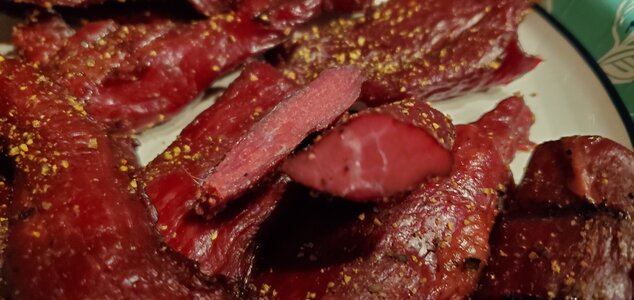
Nope . 1 Tbls . per pound of whole muscle meat . I go 3 days in a bag , and mix each day .
Rinse dry and reseason with black pepper . No added salt after the rinse .
20200917_194838.jpg
 
No adjustment needs to be made to the poundage. Just know that if using acidic things like soy, you must cure the meat first for 12-24 hours before adding the soy or woorsey sauce. These acids will almost immediately burn off the nitrite and kill the actual cure affect.
I've use the Kutas recipe, it mentions cure1 in the mix

I've never seen ANY warnings about acid hurting the cure

do you have a link that I care read more on this?
 
I've use the Kutas recipe, it mentions cure1 in the mix

I've never seen ANY warnings about acid hurting the cure

do you have a link that I care read more on this?
The subject of acids (low ph) interacting with nitrite/nitrate has been widely discussed here on these forums over many years. I suggest for further reading to use the search function at the top right of the page . There are page after page of insightful reading on the subject. Also this is not an obscure subject so a quick AI search will turn up all kinds of information on ph values for various ingredients and their effects on nitrites.

It is generally accepted that ingredients with a Ph lower than ~4.8 act as nitrite scavengers and cause the early conversion of nitrite into nitric oxide gas before the sodium nitrite has a chance to diffuse into the meat. Let’s look at the Ph values on some of these common ingredients,

Vitamin C as ascorbic acid (Ph 2.1) this will cause immediate gas conversion.

Vinegar (acetic acid) Ph~2.0-3.0

Soy sauce (acetic acid diluted) Ph- 4.0-5.6

Worcestershire sauce ( vinegar, tartaric acid) Ph-3.5-4.5

Liquid smoke (carbonic acid) Ph-3.5-4.4

Any of these common ingredients applied directly to nitrite (cure #1) will cause the transformation of NO2 into NO gas before the sodium nitrite can diffuse into the meat. While some nitrite may get diffused into the meat, it’s a crap shoot as to if it’s enough to effectively cure. (Control botulism)

We do use cure accelerators like Sodium Erythorbate to speed up the cure process. It is the sodium salt of erythorbic acid, a stereoisomer of Sodium ascorbate. Which speeds the conversion of nitrite to nitric oxide, but in a controlled way, and acts as a preservative that fixes cured color of meat (also stops formation of nitrosamines) and depletes oxygen (slowing oxidation)

This Sodium Erythorbate has a Ph value of ~5.0-6.0. This is why this acid is controlled with respect to nitrite as it’s Ph is above 4.8 and is useful in curing.

I urge you to do your own independent testing, as I have, with your favorite acid ingredients. Take a few clean glasses and add a crushed up vitamin C pill dissolved in water to one, a little vinegar in one, soy sauce in one, Worcestershire in one, liquid smoke in one, maybe even orange juice in another just for fun. Then add a pinch of cure #1 to each one at a time and watch for fizz or bubbles to form. Some will be instantly others may take 1-2 minutes to form fizz or bubbles, but this is the gassing off of nitrite converting to nitric oxide.
 
The subject of acids (low ph) interacting with nitrite/nitrate has been widely discussed here on these forums over many years. I suggest for further reading to use the search function at the top right of the page . There are page after page of insightful reading on the subject. Also this is not an obscure subject so a quick AI search will turn up all kinds of information on ph values for various ingredients and their effects on nitrites.

It is generally accepted that ingredients with a Ph lower than ~4.8 act as nitrite scavengers and cause the early conversion of nitrite into nitric oxide gas before the sodium nitrite has a chance to diffuse into the meat. Let’s look at the Ph values on some of these common ingredients,

Vitamin C as ascorbic acid (Ph 2.1) this will cause immediate gas conversion.

Vinegar (acetic acid) Ph~2.0-3.0

Soy sauce (acetic acid diluted) Ph- 4.0-5.6

Worcestershire sauce ( vinegar, tartaric acid) Ph-3.5-4.5

Liquid smoke (carbonic acid) Ph-3.5-4.4

Any of these common ingredients applied directly to nitrite (cure #1) will cause the transformation of NO2 into NO gas before the sodium nitrite can diffuse into the meat. While some nitrite may get diffused into the meat, it’s a crap shoot as to if it’s enough to effectively cure. (Control botulism)

We do use cure accelerators like Sodium Erythorbate to speed up the cure process. It is the sodium salt of erythorbic acid, a stereoisomer of Sodium ascorbate. Which speeds the conversion of nitrite to nitric oxide, but in a controlled way, and acts as a preservative that fixes cured color of meat (also stops formation of nitrosamines) and depletes oxygen (slowing oxidation)

This Sodium Erythorbate has a Ph value of ~5.0-6.0. This is why this acid is controlled with respect to nitrite as it’s Ph is above 4.8 and is useful in curing.

I urge you to do your own independent testing, as I have, with your favorite acid ingredients. Take a few clean glasses and add a crushed up vitamin C pill dissolved in water to one, a little vinegar in one, soy sauce in one, Worcestershire in one, liquid smoke in one, maybe even orange juice in another just for fun. Then add a pinch of cure #1 to each one at a time and watch for fizz or bubbles to form. Some will be instantly others may take 1-2 minutes to form fizz or bubbles, but this is the gassing off of nitrite converting to nitric oxide.
Thanks for the information
I'll certainly be doing some more reading
 
SmokingMeatForums.com is reader supported and as an Amazon Associate, we may earn commissions from qualifying purchases.

Latest posts

Back
Top
Clicky