• Some of the links on this forum allow SMF, at no cost to you, to earn a small commission when you click through and make a purchase. Let me know if you have any questions about this.

First go at snack sticks.

SmokingMeatForums.com is reader supported and as an Amazon Associate, we may earn commissions from qualifying purchases.

Steve H

Epic Pitmaster
OTBS Member
SMF Premier Member
Joined
Feb 18, 2018
Messages
13,030
Reaction score
15,772
Location
Newark New York
This Sunday will be my first attempt at snack sticks. I'm going to use TSM pepper stick sausage kit. Has anyone used this before? And if so, how was it? Did it need any more spices?
They will be stuffed into 19mm smoked collagen casings.
I also bought 5 pounds of Hickory dust.
Though the instructions say to stuff and smoke right away. I thought it was common practice to stuff and then smoke them the next day. Any tips would be welcome.
 
SH, You can mix and let sit for a day and then stuff or stuff first and let sit for a day. I always let it sit for a day before smoking.I never tried the TSM mix but you will have to let us know how it works out.
 
Grind and stuff IMMEDIATELY is very good advice.. you do not want the meat to"stiffen" due to the proteins coagulating,...
 
Grind and stuff IMMEDIATELY is very good advice.. you do not want the meat to"stiffen" due to the proteins coagulating,...

That's what I always do for SS. Then I let it sit overnight before smoking. This just confused me about stuffing and smoking right away.
 
Steve, can you share your recipe for snack sticks and the process you are going to use?

According to the recipe from TSM provided with the kit. You add the spices with a pint of water and the cure. mix, stuff, and smoke. I'm only doing a 5 pound batch. So that will be cut in half. Then a few hours in the smoker at 120 with smoke. Then bump to 165 until IT is 155-160. Then ice bat. Then in the fridge uncovered for the overnight to bloom.
 
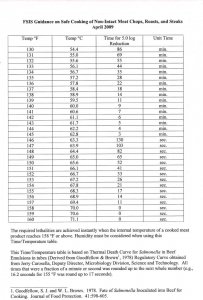
Steve, morning.... There is a pasteurization table that works well with sticks... I use it.....
The chart shows that at 135F for 28 minutes, it is safe to eat... Personally I hold my sticks at ~135 for an hour or 2 for insurance.... Smoker temps may not be even... Thermometer may be off a few degrees....
The up side... No possible fat out... My sticks come out soft and tender... I run my smoker at ~155F ... I do use STPP to maintain the moisture...
pasteurization non intacttable 005.jpg
 
Thanks Dave.
I don't have any STPP. I'll need to run this one without it. I'll try to get some for the next batch. And I'll follow your lead on the temp/hold time. Good info. Appreciate it! How much of the STPP do you use in a 5 pound batch?
 
One other thing you may want to fool around with is once you have everything mixed go fry up a test patty and see if the salt is too strong or the flavor too weak. This will let you know if you need to tweak before you put in all that hard work to get a super salty or super bland stick :)
 
Dave, is that chart good for venison, pork and beef ? Use all at different times when making sticks or summer sausage. I did see at bottom it says for salmonella in beef. Just curious because I normally take mine up to 160° range.
 
Thermal Death Time Curve.png


FWIW, those tests were probably done in a Laboratory using a petri dish.... exaggerate the times...

Salmonella and listeria are some of the most difficult microorganisms to kill.... If you can kill them in beef, pork, poultry... They "should" die in venison.... (so it says in fine print) .... I'm not aware that the meat makes any difference...
The above chart shows the time and temp required to kill them.....
NOW.... that being said, it's the bug that must get to that temperature, so evaporative cooling has some effect on them staying alive.....
ALSO, it has been shown, the meat and bugs needs to be wet before that happens.....
That is why, dehydrating meat such as jerky, they can live due to a "sort of" suspended animation the slowly dried out critters can morph into... the critters will be "reborn" when they hit your warm, moist guts.... That's also why the recommendation to heat the meat in your marinade, then dehydrate, is so important...

That wording kind of sucks but I don't know how to put it into a "clean" statement....

At 160, stuff dies instantly.... at 150 ish, it takes ~2 minutes... at 135 it takes ~ 28 minutes....

ALWAYS overshoot those times, for your own and family safety...
 
Thanks Dave.
I don't have any STPP. I'll need to run this one without it. I'll try to get some for the next batch. And I'll follow your lead on the temp/hold time. Good info. Appreciate it! How much of the STPP do you use in a 5 pound batch?

I use 0.4%..... The rate is 0.3% to 0.5%.... Soooo, 5#'s = 2270 grams X 0.004 = 9 grams of STPP... It does an amazing job of maintaining moisture in meat.....
 
Dave, is that chart good for venison, pork and beef ? Use all at different times when making sticks or summer sausage. I did see at bottom it says for salmonella in beef. Just curious because I normally take mine up to 160° range.

If doing wild pork or bear meat you will want to ensure you hit an IT of 165F or a little higher to kill parasites. Farm raised store stuff... I'm sure Dave has you covered. The man is good!
 
I use 0.4%..... The rate is 0.3% to 0.5%.... Soooo, 5#'s = 2270 grams X 0.004 = 9 grams of STPP... It does an amazing job of maintaining moisture in meat.....

Thanks Dave. I will keep this in mind.
 
Trichinosis
Food preparation

Larvae may be killed by the heating or irradiation of raw meat. Freezing is normally only effective for T. spiralis, since other species, such as T. nativa, are freeze resistant and can survive long-term freezing.[14]

All meat (including pork) can be safely prepared by cooking to an internal temperature of 165 °F (74 °C) or higher for 15 seconds or more.

Wild game: Wild game meat must be cooked thoroughly (see meat preparation above) Freezing wild game does not kill all trichinosis larval worms. This is because the worm species that typically infests wild game can resist freezing.
  • Pork: Freezing cuts of pork less than 6 inches thick for 20 days at 5 °F (−15 °C) or three days at −4 °F (−20 °C) kills T. spiralis larval worms; but this will not kill other trichinosis larval worm species, such as T. nativa, if they have infested the pork food supply (which is unlikely, due to geography).

Pork can be safely cooked to a slightly lower temperature, provided that the internal meat temperature is at least as hot for at least as long as listed in the USDA table below.[22] Nonetheless, it is prudent to allow a margin of error for variation in internal temperature within a particular cut of pork, which may have bones that affect temperature uniformity. In addition, kitchen thermometers have measurement error that must be considered. Pork may be cooked for significantly longer and at a higher uniform internal temperature than listed below to be safe.

Internal Temperature Internal Temperature Minimum Time
F)....
(minutes)
120..... ....1260
122 .......... 570
124........... 270
126...........120
128 .......... 60
130........... 30
132........... 15
134........... 6
136........... 3
138 .......... 2
140 ...........1
142 ...........1
144 ........... Instant
[22]

Unsafe and unreliable methods of cooking meat include the use of microwave ovens, curing, drying, and smoking, as these methods are difficult to standardize and control.[14]
 
Stuffed and ready for the morning. I had a bit of a learning curve with these 19mm casings. Had a couple blow outs from not watching what I was doing. All in all. I think I did ok. Tomorrow will tell the tale..

P4131897.JPG
 
An hour in. And the PID control I put together is working great. I'm getting a 2 degree swing which I'm more then happy with.
 
SmokingMeatForums.com is reader supported and as an Amazon Associate, we may earn commissions from qualifying purchases.

Latest posts

Back
Top
Clicky